
Louisville Move Timeline: 30, 60, 90 Days
A 90/60/30-day Louisville moving checklist for booking movers, scheduling utilities, enrolling schools, and confirming possession.
- Agent Selection
- Local Market
- Real Estate

I’d plan a Louisville move backward from possession - not closing. First, write down when you close, when you get access, and when your belongings arrive. Those can be three different dates.
Here’s how I’d split the work:
- 90 days out: Set housing goals, choose a Realtor if needed, gather documents, estimate costs, and check school assignments.
- 60 days out: Book movers, track contract deadlines, declutter, start packing, request school records, and check utility providers.
- 30 days out: Confirm access, schedule utilities, finish enrollment, update addresses, and pack a first-night bag.
- Moving day and the first week: Check both homes, document delivery damage, test home systems, and finish school, mail, and account updates.
Moving between Kentucky and Southern Indiana? I’d verify schools, utilities, and state requirements separately. <u>Don’t assume they transfer with you.</u> Kentucky residents must update their Kentucky license or credential address within 10 days of moving.
My rule: keep every deadline, contact, and confirmation in one tracker - and revise it whenever your dates change.
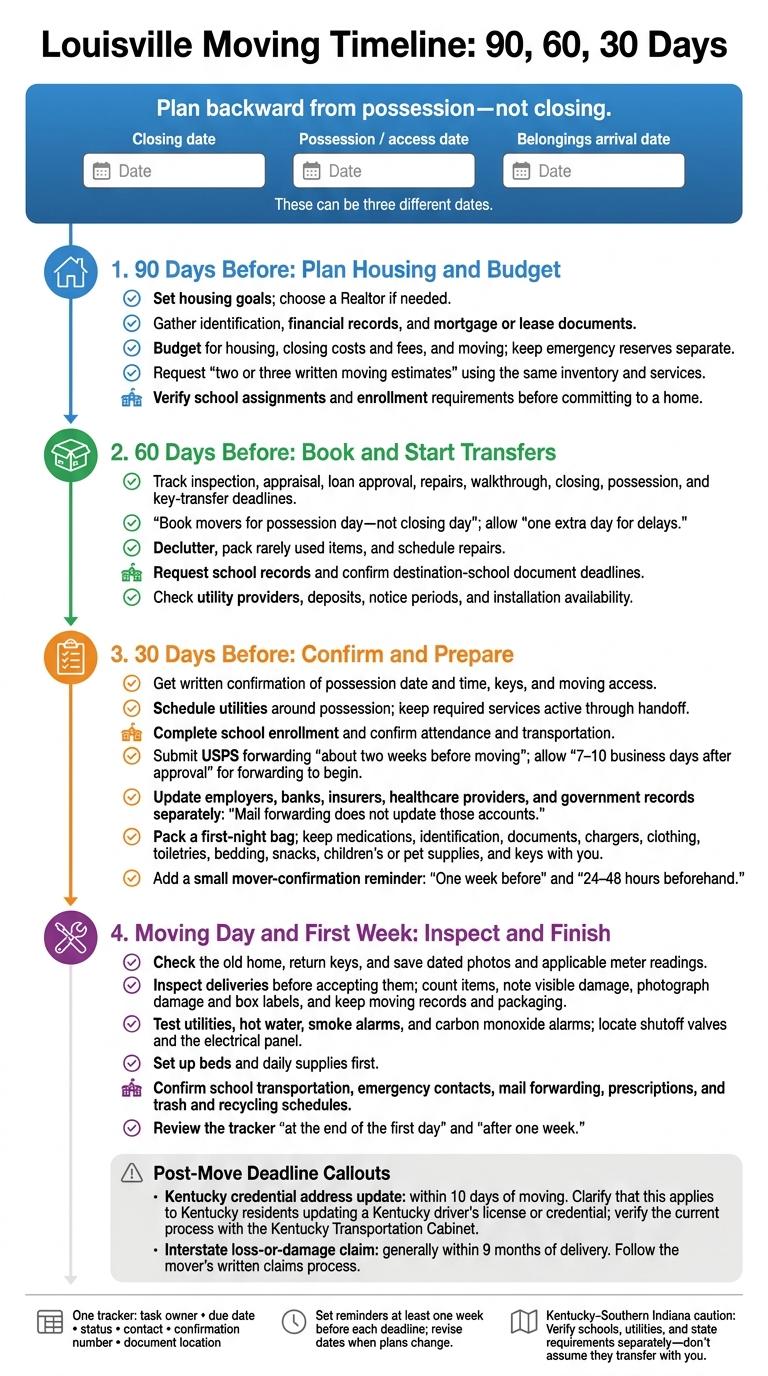
Louisville Moving Timeline: 90, 60, 30 Days
90 Days Before: Plan Your Housing and Budget
Set Housing Goals and Choose a Realtor
Start by deciding whether you’re buying, selling, renting, or handling a purchase and sale together. Write down your move date, target area, commute limit, home type, size and accessibility needs, and must-have features. Separate what you need from what you’d like. Test commute routes during the hours you’ll actually travel.
Your next steps depend on your plans:
- Buying: Set a target price range and a monthly payment limit.
- Selling: Choose a listing date, outline preparation work, and set your preferred closing window.
- Renting: Check lease timing, deposit limits, pet rules, and application requirements.
With those targets in place, gather the documents and costs you’ll need to plan the move.
If you’re buying and selling at the same time, ask your Realtor how to line up move-out and move-in dates. Before signing an agreement, review their experience in your target neighborhoods, recent comparable transactions, and availability during your timeline. Discuss how they communicate, handle offers and negotiations, and guide clients through inspections and repairs. Also review compensation, the agency relationship, and cancellation terms.
Need a Realtor? Agent Intro can connect you with one local agent based on experience, availability, and working style.
Gather Documents and Estimate Moving Costs
Create a secure digital folder and, if needed, a physical file. Include identification, income and employment records, bank and investment statements, lender paperwork, and mortgage or lease information. Sellers should also add deeds, surveys, HOA records, disclosures, and repair receipts.
Ask your lender for a document checklist now. Use approved secure upload systems to share sensitive records.
Keep a deadline tracker with each task’s owner, due date, status, contact, confirmation number, and document location. Set reminders at least one week before each deadline.
Build your budget in U.S. dollars around three categories: housing, closing costs and fees, and moving. Account for taxes, insurance, HOA dues, inspections, repairs, movers, supplies, storage, utility deposits, and any period when you’ll pay for both homes. Keep your emergency reserve separate.
Request two or three written moving estimates based on the same inventory and services so you can compare them. For an interstate move, ask for an in-home or virtual survey and confirm whether each estimate is binding or nonbinding.
Check School Assignments and Enrollment Rules
If children are moving with you, check school placement before you commit to a home. For every address on your shortlist, verify the district, assigned school, grade-level availability, enrollment process, required documents, transportation eligibility, and start dates. The nearest school isn’t always the assigned school.
Check JCPS SchoolFinder, then direct address-specific questions to the Office of School Choice at (502) 485-6250. Ask separately about magnet and optional-program applications, including the school year your child will enter.
For other Kentucky or Southern Indiana districts, contact the district directly and save its written confirmation before choosing a home.
60 Days Before: Book Moving Help and Start Transfers
Track Housing Deadlines and Book Moving Help
With your home target set, spend the next 30 days booking moving help and starting transfers. Create one timeline for inspection responses, appraisal, loan approval, repairs, walkthrough, closing, possession, and key transfer. Book movers for possession day - not closing day - and allow one extra day for delays. Check date-change terms before paying a deposit.
Get a written moving estimate that covers labor, mileage, packing, stairs, long carries, bulky-item fees, storage, travel charges, valuation coverage, payment terms, and damage reporting. Released-value protection limits liability to $0.60 per pound per article. For a Kentucky–Indiana move, verify the mover’s federal operating authority and insurance through FMCSA. Kentucky-only movers need Kentucky Transportation Cabinet licensing. Reserve your movers, truck, or storage now.
Declutter, Start Packing, and Schedule Repairs
Work through one room at a time, sorting items into keep, donate, sell, and discard groups. Start packing seasonal clothing, holiday decorations, books, and rarely used kitchenware. Label each box with its destination room and opening priority. Keep valuables, medications, and critical records with you, not in the moving shipment.
If you’re selling, finish visible repairs before photos and showings. Skip major work that could delay closing. Plan cleaning and landscaping around showings, and save repair receipts, warranties, and any required permits.
Request School Records and Check Utility Providers
Ask your current school about withdrawal timing and record transfers. Request transcripts, attendance, immunization, testing, and IEP records. Before arranging withdrawal, confirm the destination school’s document deadlines, including those for proof of residency and custody paperwork. JCPS families should request records through their child’s school.
Find the electricity, gas, water, sewer, trash, internet, and security providers for your new address. Ask about notice periods, deposits, activation fees, installation openings, and equipment returns. LG&E and KU may require identification, meter access, and your previous account number to transfer service. If activation timing is unclear, ask for written confirmation of the earliest appointment and whether someone must be present.
30 Days Before: Confirm Access, Utilities, and Address Changes
Confirm Possession and Moving-Day Access
Use the last 30 days to settle access details, utility schedules, and address changes. Get written confirmation of your possession date and time, key pickup arrangements, and any leaseback or post-closing occupancy terms. Find out who can authorize entry if closing is delayed.
Confirm truck parking, loading access, elevator reservations, certificate-of-insurance requirements, and move-in fees. Recheck the mover’s arrival window one week before the move and again 24–48 hours beforehand.
Compare your final inventory with the written estimate, confirm payment instructions, and finish agreed repairs and cleaning by the contract deadlines.
Sellers should gather all keys, including mailbox keys, plus remotes, alarm information, manuals, warranties, paint details, appliance instructions, and access codes. During the final walkthrough, buyers should document the property, check that included fixtures remain, and photograph utility meters and existing damage. Report any discrepancies promptly to the local agent or professionals handling the transaction.
Schedule Utilities and Complete School Enrollment
Now’s the time to handle tasks tied to your new address and start date. Keep required utilities active through handoff, and schedule new-home activation around possession - not just closing. Save confirmation numbers and installation windows for electricity, gas, water, internet, and other services.
Submit school records, proof of residence, immunization records, custody papers, and required enrollment forms. Check with JCPS or the receiving district to confirm application status, the first attendance date, transportation eligibility, and before- and after-school care. Keep written confirmations and any missing-document notices.
Update Your Address and Pack a First-Night Bag
Check official Kentucky or Indiana agency guidance for driver’s license, vehicle registration, voter registration, and tax requirements. Start tasks that only require identification or appointments now. Leave residency-based updates until after you move.
Submit USPS mail forwarding about two weeks before moving, and allow 7–10 business days after approval for forwarding to begin. Update employers, banks, lenders, insurers, healthcare providers, subscriptions, and government records separately. Track each effective date and confirmation number. Mail forwarding does not update those accounts.
Pack a first-night bag with medications, identification, closing documents, chargers, clothing, toiletries, bedding, snacks, children’s or pet supplies, and keys. Keep it with you - not on the moving truck.
The Complete Moving Checklist on How to Organize Your Move
Conclusion: Finish Moving-Day and First-Week Tasks
Once possession is complete, use this move-in prep checklist to finish moving-day tasks and first-week updates.
Check the Old Home and Inspect Deliveries
Before leaving the old home, check closets, cabinets, the attic, garage, and storage areas for anything left behind. Complete the final walkthrough, return all keys, and keep confirmation and dated photos. Save any applicable meter readings for final bills.
Inspect deliveries before accepting them. Count items against the inventory, record visible damage on the delivery paperwork, and photograph damaged items beside their box labels. Keep the packaging and moving records, then follow the mover’s written claims process. For an interstate move, you generally must file a written loss-or-damage claim within 9 months of delivery.
Check Services and Finish First-Week Updates
After the truck is unloaded, check home systems and local services in this order: test utilities, hot water, smoke alarms, and carbon monoxide alarms, then locate shutoff valves and the electrical panel. Set up beds and daily supplies first.
During the first week, verify school transportation and emergency contacts. Confirm mail forwarding, prescription transfers, and the trash and recycling schedule for your address.
Review Remaining Tasks and Deadlines
Assign each unfinished task from your 30/60/90-day plan to one person. Track the remaining post-move deadlines below, replacing role labels with household members’ names and adding actual confirmation numbers.
| Task | Responsible person | Target date | Confirmation number | Status |
|---|---|---|---|---|
| Inspect delivery and report missing or damaged items | Buyer/seller | Delivery day | Claim number | Open |
| Confirm first-day attendance and transportation | Parent/guardian | First school day | Enrollment or transportation reference | Open |
| Submit outstanding address updates to banks and insurers | Assigned adult | First week | Submission confirmation | Open |
| Confirm first pickup day | Assigned adult | First week | Provider account number | Open |
Review the tracker at the end of the first day and again after one week. Update dates whenever possession, closing, lease commencement, school enrollment, utility activation, or delivery timing changes.
Verify outstanding requirements directly with the receiving district, providers, and state agencies. Kentucky residents who move must update the address on their Kentucky driver’s license or credential within 10 days. Confirm the current process with the Kentucky Transportation Cabinet.
FAQs
How can I condense my Louisville move into 30 days?
Tell your agent your firm move date on the first call and ask them to plan backward from it. Get preapproved right away to guide your home search and how you structure offers. Focus on areas where your agent has sold homes in less than the average 44–48 days on market.
Once you’re under contract, track every deadline - including inspections and appraisals - on one calendar. Respond to document requests immediately to keep your closing on schedule.
What if my closing is delayed after I book movers?
Contact your real estate agent right away. Closing dates are legally binding. If you miss yours, the seller may have grounds to cancel the purchase agreement. Your agent will need to negotiate an addendum to extend the deadline, and the seller must approve it.
Before booking movers, confirm your possession terms in writing. Your moving date should line up with when you’ll get the keys and access to the home.
How do I coordinate buying and selling without moving twice?
Talk with your real estate agent early about firm move-out dates and how each transaction depends on the other financially. Selling first gives you a clearer budget for your next home, but you may need temporary housing. Buying first could mean paying for two homes at once.
A written rent-back agreement is another option to negotiate. It lets you stay in your current home after closing, giving you more time to move into your next one.
Ready for a thoughtful introduction?
Tell us about your move. Get one carefully selected introduction. No obligation to hire.
Find my agent ↗