
Relocating to Louisville: How to Find a Local Agent
Set search rules and test 2–3 agents on neighborhood knowledge, cross-river licensing, and contract terms before you sign.
- Agent Selection
- Local Market
- Real Estate

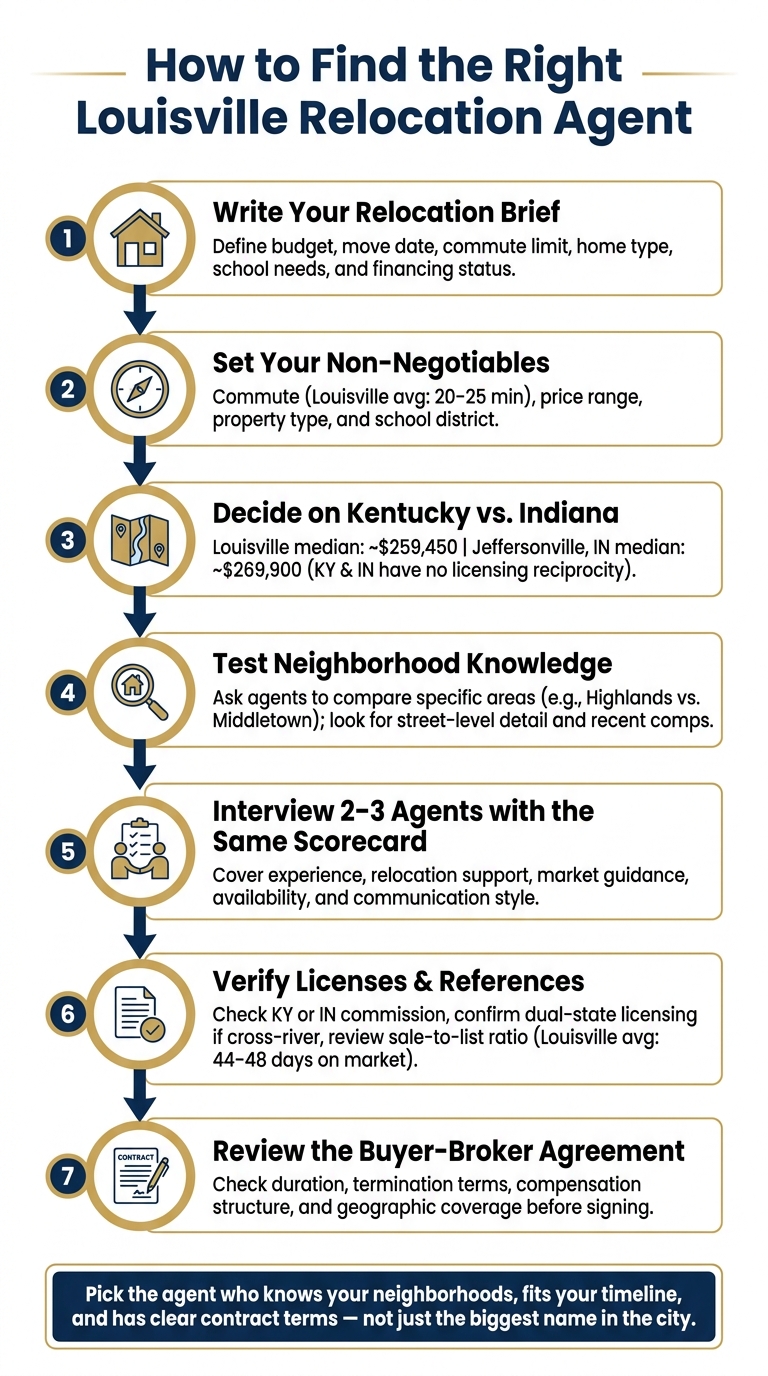
If I were moving to Louisville from out of state, I’d pick one agent only after testing three things: neighborhood knowledge, cross-river coverage, and contract terms.
This comes down to a simple plan. I’d first write a short move brief with my budget, move date, commute limit, school needs, and financing status. Then I’d ask each agent the same questions about Louisville areas, taxes, flood zones, schools, bridge traffic, and whether they can help in both Kentucky and Southern Indiana. Last, I’d compare their answers, check licenses, and read the buyer agreement before signing.
Here’s the short version:
- Set my search rules first: budget, timeline, home type, commute, and schools
- Decide if Indiana is part of the search: Louisville median sale price was about $259,450, while Jeffersonville was about $269,900 in early 2026
- Test local knowledge: ask agents to compare areas like the Highlands and Middletown
- Check street-level facts: schools, taxes, flood zones, and road access
- Use one scorecard: compare 2–3 agents with the same questions
- Verify the setup: licenses, references, recent sales, and buyer-broker terms
- Pick the best fit for my move: not the biggest name, but the person who knows my area and timing
A few numbers help frame the move:
- Many Louisville commutes fall around 20–25 minutes, but route and bridge traffic can change that fast
- South Louisville homes often land around $150,000–$300,000
- Oldham County homes often run about $350,000–$700,000+
- Louisville homes averaged about 44–48 days on market
How to Find a Local Real Estate Agent When Relocating to Louisville
What Real Estate Agents DON’T TELL YOU About Living in Louisville!
Quick comparison
| What I’d check | Why it matters |
|---|---|
| Budget and target areas | Prices can shift a lot by neighborhood and county |
| Kentucky-only vs. Indiana search | Licensing rules differ across the state line |
| Neighborhood comparisons | Broad “I know Louisville” claims don’t tell me much |
| Schools, taxes, flood zones | These can change monthly cost and day-to-day life |
| Relocation process | I’d want virtual tours, remote paperwork, and closing help |
| Agreement terms | Duration, pay terms, ending the contract, and service area all matter |
If I keep the process this simple, I can cut through vague sales talk and choose an agent who fits my move, my budget, and my timeline.
Define your move before you contact agents
Before you reach out to agents, put together a one-page relocation brief. Keep it simple, but make it specific: your move date, budget, financing status, home type, commute limit, and school needs. That one page gives you a fast way to sort through agents and steer each conversation in the right direction.
Think of it as your filter. Instead of starting from scratch every time, you can quickly tell whether an agent fits what you need.
List the non-negotiables that shape your search area
Start with the items you won't bend on: commute, home type, price range, and school needs. Those four points will do a lot of the heavy lifting.
In Louisville, many commutes fall in the 20–25 minute range. But that can change based on where you'll be working, so don't treat that number as fixed. A 20-minute drive on paper can feel very different depending on the route and time of day.
It also helps to choose your property type early. Historic neighborhoods often bring character and walkability. On the other hand, newer construction in the East End and Oldham County usually means larger lots and top-rated schools. Those are two very different paths, and an agent needs to know which one you're leaning toward before suggesting areas.
Once you've nailed down those priorities, move to the next screen: can the agent help on both sides of the river?
Decide whether you need Kentucky-only, Indiana-cross-river expertise
A lot of relocating buyers miss this part, and it can slow everything down.
If Indiana is even a maybe, ask right away whether the agent is licensed there or has a referral partner across the river. Kentucky and Indiana do not have licensing reciprocity, so this isn't a small detail.
As of early 2026, the median sale price was about $259,450 in Louisville and $269,900 in Jeffersonville, Indiana. That price gap may shape where you look, especially if you're comparing budget, commute, and taxes at the same time.
If you're open to homes on either side of the Ohio River, say that plainly in your relocation brief. It saves time and helps the agent guide you with the right options from the start.
"Southern Indiana can be more affordable in some cases, especially with taxes, but it depends on your commute, job location, and housing goals." - Ryan Cecil, Realtor
Test whether an agent knows Louisville at the neighborhood level
Once you know your target areas, push past broad claims and test how well the agent knows Louisville at the street level. Saying “I know Louisville” sounds nice, but it doesn’t tell you much. You want to hear how they know it. The fastest way to find out is to ask them to compare two or three areas that fit your budget and commute.
Ask the agent to compare neighborhoods that fit your budget and commute
A good agent won’t stop at naming neighborhoods. They’ll spell out the trade-offs in plain English.
Ask them to compare the Highlands and Middletown, for example. The Highlands offers walkability and architectural character, but older homes can also bring more maintenance and renovation needs. Middletown tends to have newer construction and larger lots, but you’ll rely more on driving.
Pay attention to how specific they get. If the answer feels vague, or they talk about these areas like they’re basically the same, that tells you something. A local agent should be able to mention specific streets and back up their view with recent comparable sales.
Check for knowledge of schools, taxes, flood zones, and road access
Ask how they confirm details for the exact address you’re thinking about. A local agent should be able to point you to the right official sources and flag issues before they turn into nasty surprises after closing - things like school boundaries, tax structure, flood zones, or road access.
Use those answers to rank agents on the same scorecard.
Interview and compare agents using the same scorecard
After you test neighborhood knowledge, meet with two or three agents and ask the exact same questions in the exact same order. That makes the comparison much cleaner. You're not judging who is the most charming. You're checking who can back up their claims with proof.
Cover five interview topics: experience, relocation support, market guidance, availability, and working style
Start with experience. Ask how many homes they closed in your target neighborhood in the last 12 months. Then ask for their sale-to-list ratio. This matters even more if you're buying from out of town, where you need someone who knows the area block by block. Push for numbers, not broad statements.
"local market expertise at the neighborhood level matters far more than name recognition or general volume." - Laura Rice and Associates
Next, ask about relocation support. Be direct: do they offer virtual tours, remote paperwork, closing coordination, and local vendor referrals? A good relocation agent should already have a process for out-of-town buyers. You don't want someone making it up on the fly.
For market guidance, ask how they deal with multiple offers and appraisal gaps in hot neighborhoods. This is where an agent's judgment shows up fast. You want someone who can explain the tradeoffs in plain English and help you move without panic.
Then cover availability and working style. Ask how fast they usually reply to texts and emails. Find out whether you'll work with the agent directly or mostly with a team member. Also ask how they guide buyers. Some agents lead every step. Others take a lighter approach and expect you to steer more of the process. Neither setup is wrong, but a bad fit can wear on you fast.
To keep things objective, write down each answer in the same order:
| Category | Agent A | Agent B | Agent C |
|---|---|---|---|
| Primary service area | |||
| Recent transactions (target neighborhood, last 12 months) | |||
| Relocation support (virtual tours, remote paperwork, closing coordination) | |||
| Availability (response time, direct contact) | |||
| Communication style (text/email/phone) | |||
| Strengths | |||
| Concerns | |||
| Overall fit |
Verify licenses, references, and recent client results
Once the interviews are done, check the claims before you cut your list down. Verify the agent's license with the Kentucky or Indiana commission before you sign anything. Neither state has automatic reciprocity with the other. So if you're looking at homes on both sides of the river, the agent needs either dual licensing or a formal, documented referral partner in the other state. If you're buying in Kentucky, ask to review the buyer-broker agreement they use before you tour homes.
"A referral is not enough if it is just a name in a text message. For a long-distance move, you need a real system." - Paul Kiger, Paul Kiger Group
You should also ask for references from clients in situations like yours, such as out-of-state moves, tight timelines, or competitive-offer markets. Then look at days on market and sale-to-list ratio in your target area. Homes in Louisville averaged about 44–48 days on market. If an agent beats that in the part of town you're targeting, that's a strong sign they're worth a closer look.
Once one agent stands out on paper, you're ready to move to the agreement.
Choose one agent and move forward
Once your scorecard is done, pick one agent and take a close look at the agreement before you move ahead.
The choice comes down to a simple test: which agent fits your neighborhoods, timeline, and price point? The best fit usually isn't the agent with the most listings across the city. It's the agent who's closed deals in the neighborhoods you want, around your budget, on a timeline that lines up with your move.
What to review before signing an agreement
Before you commit, read the buyer-broker agreement with care. This contract shapes the working relationship, so the details matter.
Focus on a few things:
- Duration: How long does the agreement last?
- Termination language: How can either side end the relationship?
- Compensation structure: How is the agent paid, and what happens if a seller doesn't offer a buyer's agent commission?
- Geographic coverage: Does the agreement match the areas where you plan to buy?
A broad service area can sound fine on paper, but it may not mean the agent knows your target neighborhoods well. That's worth clearing up early.
You should also confirm that the agent has room in their schedule during your move window. Timing can make or break a relocation. And if your home search may cross the state line into Southern Indiana, check for dual-state licensing before you sign.
"A clearly written buyer-broker agreement is actually a sign of a professional, transparent agent who is committed to representing your interests properly." - Laura Rice and Associates
Key takeaways for relocating to Louisville
Pick the agent whose neighborhood knowledge, response speed, and contract terms line up best with your move. You want someone who knows your target areas, can protect your timeline, and can help you buy across Louisville's commute corridors, school boundaries, and cross-river options with solid local judgment.
FAQs
How many agents should I interview?
Talk to a few agents before you choose one. There’s no magic number, but speaking with several people gives you a better feel for their communication style, local market knowledge, and past results.
If you can, start a few months before your move. That gives you time to compare options, ask about specific Louisville neighborhoods, and get comfortable with an agent before the process starts to feel rushed.
Do I need an agent licensed in both Kentucky and Indiana?
Yes - if you’re considering homes in both Kentucky and Indiana, your agent must be licensed in both states.
That comes up a lot in the Louisville area. Louisville and Southern Indiana are tightly connected, so plenty of buyers look on both sides of the river during the same home search.
If you’re only shopping in one state, though, an agent licensed in that state is enough.
What should I review before signing a buyer agreement?
Before you sign a buyer-broker agreement in Louisville, check the agent’s license in Kentucky’s official state database. It’s a simple step, and it helps you confirm you’re dealing with someone properly licensed.
Then read the agreement closely. Pay extra attention to the length of the contract, the termination terms, and the exact area or property types it covers. Some agreements apply across the full Louisville metro area, while others may only cover certain neighborhoods or specific kinds of homes.
You’ll also want to pin down compensation. Ask what you might owe if the seller doesn’t offer a commission, and make sure you understand every payment term before signing. Those terms are negotiable, so don’t assume the first version is set in stone.
Ready for a thoughtful introduction?
Tell us about your move. Get one carefully selected introduction — free for buyers and sellers.
Find my agent ↗