
Buying a Home in Louisville: What to Expect
Plan for 8 steps, 2–5% closing costs, inspections, appraisal gaps, and county trade-offs when buying a home in Louisville.
- Agent Selection
- Local Market
- Real Estate
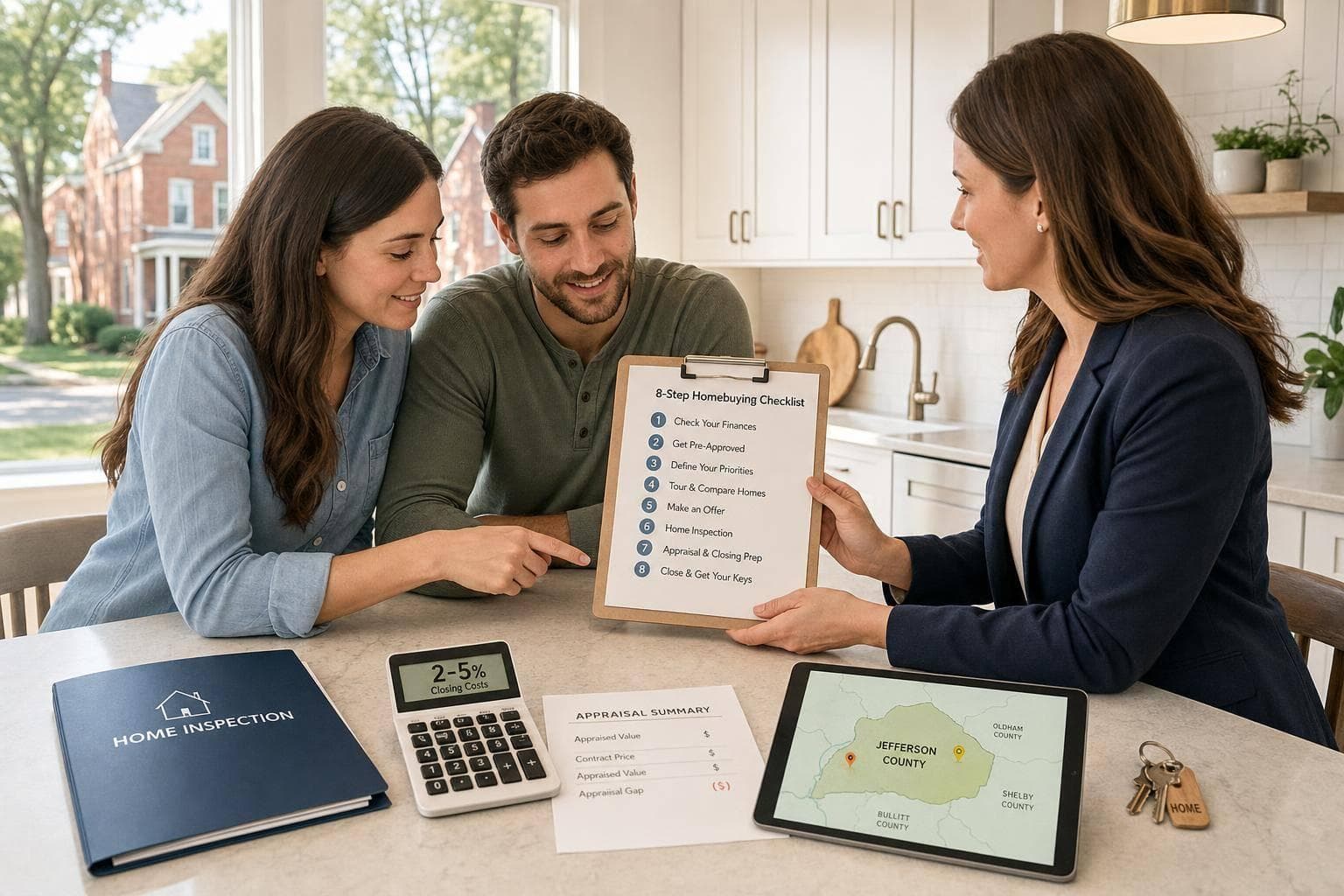
Buying a home in Louisville usually takes more money, more paperwork, and more time than most buyers expect. If I were starting today, September 26, 2026, I’d plan for 8 main steps, closing costs of about 2% to 5%, and a closing timeline that can stretch if inspections, the appraisal, financing, or title work hit a problem.
Here’s the short version: I need to know my full budget before I shop, compare counties before I fall in love with a house, write a clear offer, stay on top of deadlines, and confirm how closing works if I buy in Southern Indiana instead of Kentucky. That’s what drives most of the stress, cost, and timing.
What I’d expect, in plain terms:
- Money first: cash for the down payment, earnest money, inspections, appraisal, closing costs, and move-in expenses
- Loan prep first, tours second: preapproval shapes what I can shop for
- Location changes the deal: Jefferson, Oldham, Bullitt, Shelby, Clark, and Floyd counties all come with different taxes, utilities, school setups, commute trade-offs, and rules
- Offer terms matter: price is only one part; deadlines, contingencies, possession, and appraisal-gap terms can decide whether the deal works
- Inspections can change everything: I may ask for repairs, credits, a price cut, accept the house as-is, or walk away
- A low appraisal can mean more cash: if the value comes in under contract price, I may need to renegotiate or cover the gap
- Closing is not just signing papers: underwriting, title review, insurance, final walkthrough, and wired funds all need to line up
- Move-in starts right away: locks, utilities, tax exemptions, and early repairs should be planned before closing day
A few numbers make this easier to picture:
- On a $300,000 home, 2% to 5% in buyer closing costs is about $6,000 to $15,000
- Earnest money is often around 1% to 3% of the purchase price
- A general home inspection often runs about $400 to $700
- Professional movers often cost around $1,000
- A credit score of 720+ often gets the best rates, while 619 or lower can make loan approval much harder
The big takeaway: I shouldn’t think of this as “find house, buy house.” I should think of it as a chain of decisions where each step affects the next one.
| Step | What I need to focus on |
|---|---|
| 1. Budget and loan | Set monthly limit and get preapproved |
| 2. Agent | Pick someone who knows the area I want |
| 3. Search | Compare homes by county, commute, utilities, and school zone |
| 4. Offer | Set price, contingencies, and timing |
| 5. Inspections | Decide what issues I can live with |
| 6. Financing and appraisal | Send docs fast and watch value closely |
| 7. Closing | Review cash to close, title, and final walkthrough |
| 8. Move-in | Handle locks, utilities, and first repairs |
If I go in with a clear budget, a short list of target areas, and a full understanding of cash to close, I cut down a lot of last-minute problems before they start.
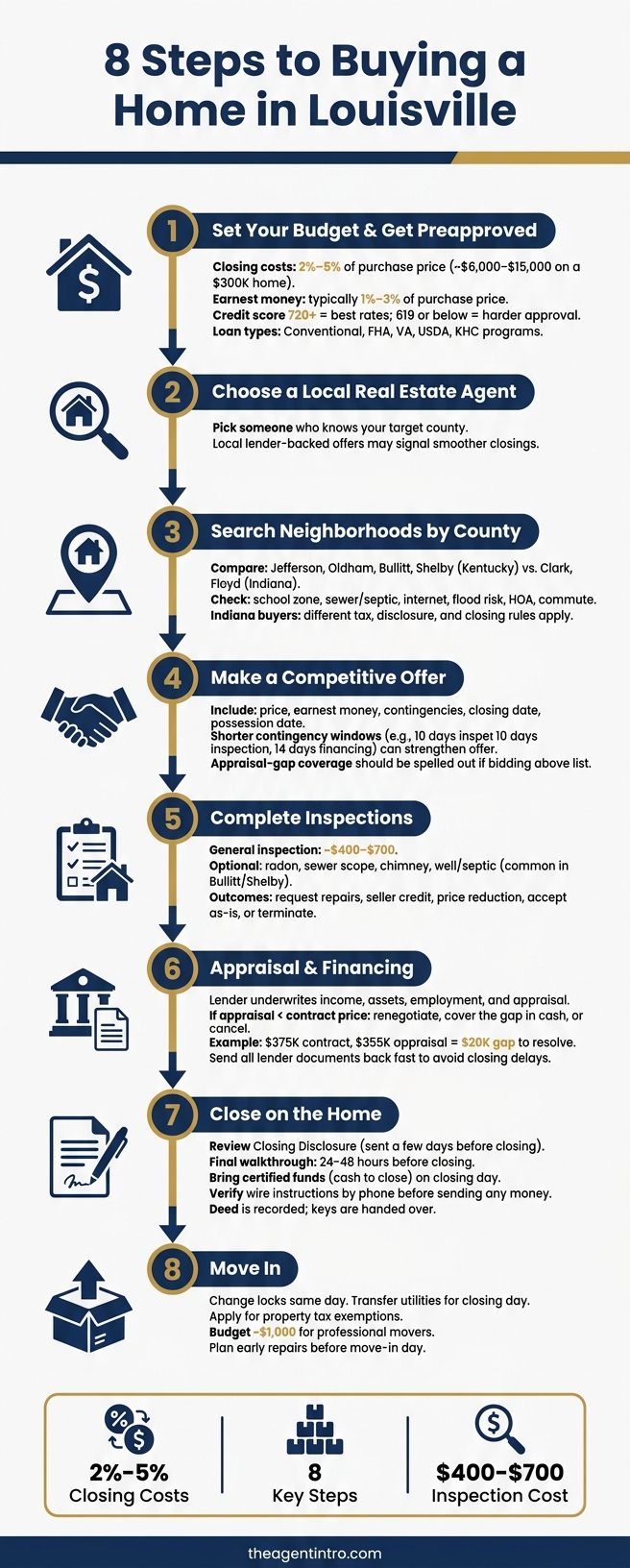
8 Steps to Buying a Home in Louisville: Costs, Timelines & Key Decisions
How To Buy A House In Louisville KY
Set Your Budget, Get Your Loan, and Define What You Need
Before you tour homes, set your budget and line up your loan. That gives you a clear price range from the start. In Louisville, that step matters a lot because buyers often have to narrow down neighborhoods before they know exactly how much home they can afford.
In Kentucky, buyer closing costs usually fall between 2% and 5% of the purchase price. On a $300,000 home, that means about $6,000 to $15,000 before you even factor in the down payment. Then pile on inspections, appraisal fees, moving costs, and money for early repairs, and the upfront total can climb fast.
Earnest money, down payment, and cash to close are three different things
These terms get mixed up all the time. And when that happens, budgets can go sideways.
Earnest money is a deposit you pay after your offer is accepted. It gets credited at closing.
The down payment is the part of the purchase price you pay at closing. The amount depends on your loan.
Total cash due at closing, often called cash to close, is the full amount you need on closing day after credits. That can include your down payment, closing costs, prepaid items, and escrow reserves.
| Cost Category | When Commonly Paid | Refundable or Credited? | What Determines Amount |
|---|---|---|---|
| Earnest Money | Shortly after offer acceptance | Credited at closing | Negotiated (often 1%–3% of price) |
| Down Payment | At closing | No (becomes equity) | Loan type and purchase price |
| Home Inspection | At time of service | No | Home size and inspector rates |
| Appraisal Fee | At application or before closing | No | Lender and property type |
| Closing Costs | At closing | No | Loan fees, title insurance, and taxes |
| Prepaid Items & Escrow Reserves | At closing | No | Property tax cycle and insurance premiums |
| Moving Expenses | After closing | No | Volume of goods and distance |
Escrow reserves are prepaid months of property taxes and homeowners insurance that lenders collect at closing.
Preapproval, loan types, and what you can afford each month
Get preapproved before you start touring homes. It shows your borrowing power and helps you move fast when the right place shows up.
Your credit score affects both your rate and your loan choices. A score of 720 or higher is considered excellent for getting the best interest rates, while scores of 619 or below may lead to a denial or much higher rates. If your score needs work, deal with that before you apply.
Loan programs don’t all work the same way:
- Conventional loans often fit buyers with solid credit.
- FHA loans allow lower down payments and are common with first-time buyers.
- VA loans offer zero down payment for eligible veterans and active-duty service members.
- USDA loans also allow no down payment for homes in eligible rural areas.
- The Kentucky Housing Corporation (KHC) offers state programs that can help eligible buyers with down payment assistance.
When you set your monthly budget, don’t stop at principal and interest. Add property taxes, homeowners insurance, PMI if it applies, and HOA dues. Then add utilities and a monthly maintenance reserve. That all-in figure is your actual monthly limit.
Once you know that number, it gets much easier to narrow Louisville-area neighborhoods by price, commute, and county rules.
Search Louisville and Kentuckiana Neighborhoods with Local Trade-Offs in Mind
Once you know your budget, the next step is to compare Louisville-area neighborhoods in a practical way: county, school zone, utilities, drainage, commute, and local rules.
Before you tour a home, check the details for that exact address. That means the school assignment, whether the property uses public sewer or a septic system, whether high-speed internet is available, and whether the lot sits in a flood-prone area or has drainage issues. You’ll also want to look at lot size, zoning, neighborhood rules, and HOA fees.
That’s why county-by-county trade-offs are often the fastest way to narrow your search.
How Louisville, Oldham, Bullitt, Shelby, Clark, and Floyd counties compare
Use your budget as a filter, then compare counties based on commute, school zone, utilities, and local rules.
Jefferson County (Louisville Metro) has a broad mix of home styles and price points. But school assignment can change by address, so verify the exact school zone for any home you’re thinking about. Older city homes may also need a closer look at maintenance and infrastructure.
Oldham County gives buyers a suburban setting outside Louisville. The big trade-off is the drive. A lower price or different home style may come with a longer commute into downtown.
Bullitt County calls for extra homework on sewer versus septic, internet access, and drive time before you settle on a spot.
Shelby County has zoning and lot-size rules that are not the same as Jefferson County. Check local rules before you make an offer.
Clark and Floyd counties follow different tax, disclosure, and closing rules than Kentucky. That affects costs, paperwork, and how the closing process works.
Crossing the Ohio River changes more than the commute
The table below compares major factors on both sides of the river. Use it as a working checklist, then confirm the details with your lender, Realtor, title company, or attorney.
| Factor | Kentucky (Louisville/Jefferson/Oldham/Bullitt) | Southern Indiana (Clark/Floyd) |
|---|---|---|
| Jurisdiction | Commonwealth of Kentucky | State of Indiana |
| Property Taxes | Rates and assessment methods set by Kentucky law; vary by county | Indiana has property tax caps; local assessments differ from Kentucky |
| State Income Tax | Kentucky income tax rules apply | Indiana has its own income tax structure |
| School Systems | JCPS or surrounding county districts | Local Indiana districts |
| Seller Disclosures | Governed by Kentucky disclosure law | Governed by Indiana disclosure law |
| Utilities | Verify sewer, water, electricity, and internet availability by address | Verify availability by address with local providers |
| Closing Professionals | Title companies are common; attorneys may be involved | Title agents are common; attorney involvement varies |
What current Louisville market numbers can and cannot tell you
You’ll see plenty of headlines about Louisville home prices, days on market, and inventory. Treat those numbers as background, not as your pricing decision.
Here’s the issue: metro-wide medians can hide big differences between neighborhoods and counties. Market conditions can still shift a lot by price range, neighborhood, and county. One home may move fast in one area, while a similar-priced home somewhere else sits for weeks.
The number that tends to help most is the sale-to-list ratio for recent closed sales in the exact neighborhood or ZIP code you want. That shows whether homes are selling above, at, or below asking price.
Ask your Realtor for a Comparative Market Analysis (CMA) based on three to five recently sold homes that are actually similar to the one you’re considering. The CMA should show clear adjustments for differences in size, condition, and features.
Use broad market data for context. Use neighborhood comps for pricing. Those comps are the baseline for your offer price.
Make an Offer, Get Inspections Done, and Negotiate the Results
Once you've found the right home, it's time to make an offer that can actually win.
A strong offer spells out your earnest money, financing, inspection terms, appraisal terms, closing date, possession date, seller credits, and any personal property included in the sale. Those details shape how serious your offer looks and how much cash you may need later.
Three terms show up a lot:
- Appraisal gap: The difference between the contract price and the appraised value.
- Title search: A records check for ownership, liens, judgments, and easements.
- Possession date: When you can move in.
The inspection period is your window to decide whether to move forward, renegotiate, or walk away. It is not a promise that the seller will fix everything. Sellers do not have to repair every issue your inspector finds.
What makes an offer competitive without overreaching
Once you know the home and neighborhood are a fit, the next job is structuring the offer for the market you're in.
Price matters. But so does the odds that the deal will close on time.
Listing agents often like offers backed by local lenders because that can signal a smoother closing process. In a tight market, that kind of detail can matter more than buyers expect.
You can also make the offer stronger without just throwing more money at it. Shorter contingency windows often help. For example, 10 days for inspections and 14 days for loans can look better than standard timelines.
Flexibility on possession can help too. If the seller needs extra time after closing, offering a rent-back period may be just as persuasive as a higher number. Sometimes that kind of breathing room is what gets the deal across the finish line.
If you bid above list price, spell out any appraisal-gap coverage in the contract. And the moment you go under contract, put every deadline on your calendar. If anything changes, use written, signed amendments.
Which inspections to order and how to respond
Once the offer is accepted, the inspection period is where the facts start to replace the sales pitch.
A general home inspection usually costs $400–$700. Depending on the property, you may also want a radon test, a wood-destroying insect inspection, a sewer-line scope, and a chimney inspection. If the home has a well or septic system - common in Bullitt and parts of Shelby County - add those too.
After you get the inspection report, you usually have five practical paths:
| Response Option | Advantage | Limitation | Best Use Case |
|---|---|---|---|
| Repair request | Seller pays | No control over contractor quality | Major safety or structural issues |
| Seller credit | You choose contractors | Lenders may cap total credits | Non-critical or cosmetic repairs |
| Price reduction | Lowers loan amount and interest | No immediate cash for repairs | When you have reserves |
| As-is acceptance | Simplifies the deal | You assume all existing defects | Competitive listings or renovation homes |
| Contract termination | Avoids a bad purchase | You lose time and inspection costs, but you avoid a bad purchase | Severe foundation failure, major mold, or similar deal-breakers |
Each option has a trade-off. A repair request may sound nice, but you may not like the seller's contractor or the quality of the work. A credit gives you more say, though lender limits can get in the way. A price cut helps with the loan, but it doesn't hand you cash for repairs on day one.
If the appraisal comes in low
After inspections, the appraisal is the next big checkpoint.
Your loan is capped by the appraised value. So if you're under contract at $375,000 and the appraisal comes in at $355,000, the lender will base the loan on $355,000. That leaves a $20,000 gap that still has to be solved.
At that point, you have three main options:
- Renegotiate to the appraised value.
- Cover the gap with cash.
- Cancel if your appraisal contingency allows it.
This is where contract terms matter a lot. A low appraisal doesn't kill every deal, but it does force both sides to make a choice.
Finish Your Loan, Close, Move In, and Find the Right Realtor
What happens between contract signing and closing day
Once the contract is signed, the deal moves out of the back-and-forth stage and into paperwork, review, and deadlines.
Your lender now underwrites the file. That means they review your income, assets, employment, and the appraisal. You’ll probably get more requests for documents, even if you already sent a lot. That’s normal. Send everything back fast, because delays on your side can push back the closing date.
At the same time, the title company or closing attorney checks the property’s title. They’re looking for unpaid liens, assessments, or ownership disputes tied to the home. If anything turns up, it needs to be fixed before closing. You’ll also be offered title insurance, which is a one-time fee that protects you if a future claim shows up against the property.
A few days before closing, your lender sends the Closing Disclosure. This document shows your final loan terms and how much cash you need to bring to closing. You’ll also need to show proof of homeowners insurance before the lender will fund the loan.
Before you wire any money, call the title company or closing attorney using a phone number you found on your own to confirm the instructions.
Here’s the final pre-closing checklist most buyers keep an eye on:
| Document or Task | Responsible Party | Deadline |
|---|---|---|
| Earnest Money Deposit | Buyer | Within 24 hours of acceptance |
| Home Inspection | Buyer / Inspector | Per contract contingency period |
| Appraisal | Lender / Appraiser | Before loan commitment |
| Title Search & Insurance | Title Company or Closing Attorney | Prior to closing day |
| Proof of Homeowners Insurance | Buyer | Before final loan approval |
| Final Walkthrough | Buyer / Realtor | 24–48 hours before closing |
| Certified Funds (Cash to Close) | Buyer | Closing day |
| Signing & Recording | Title Company or Closing Attorney | Closing day |
The final walkthrough usually happens 24–48 hours before closing. This is your last chance to make sure the home is in the condition you agreed to. Check that repairs were done, appliances and lights work, and the seller cleared out personal items and debris. If something’s off, bring it up before you sign, not after.
On closing day, you’ll sign a big stack of documents, the deed gets recorded with the county, and then you get the keys. One thing to double-check: possession doesn’t always happen right away. It depends on what the contract says, so confirm that date ahead of time.
Move-in tasks to handle right after closing
Once the keys are in your hand, take care of a few same-day items before you start unpacking.
- Change the locks.
- Transfer utilities for the day of closing so you don’t end up with a service gap.
- Apply for any property tax exemption you qualify for after closing.
- If you’re hiring movers, plan for that cost. Professional movers often cost about $1,000.
Conclusion: The decisions that matter most in a Louisville purchase
Buying a home in Louisville tends to go better when you prepare early. Get preapproved before you tour homes, and build a budget that covers more than just the monthly mortgage. Closing costs can add several percent to the cash you need at closing.
When it’s time to make an offer, keep the terms clear and spell out every deadline. The inspection and appraisal aren’t just boxes to check. They can shape the deal. A good buyer’s agent helps you stay on schedule, spot issues early, and get to the finish line without the kind of delay that makes everyone groan.
Agent Intro connects Louisville and Southern Indiana buyers with one carefully selected local Realtor based on your neighborhood, timeline, and working style. It’s free for buyers. Start at theagentintro.com.
FAQs
How much cash should I have before I start house hunting?
Before you start house hunting, make sure you have cash set aside for the main upfront costs.
That usually includes:
- the down payment
- earnest money - often 1% to 3% of the offer price
- closing costs - usually 3% to 4% of the sale price
- any appraisal gap if you bid above the appraised value
It also helps to get pre-approved before you begin your search. That gives you a clearer picture of your budget and helps confirm what you can afford.
How long does it usually take to buy a home in Louisville?
It depends on the buyer, but buying a home in Louisville usually moves through a full path: early research, touring homes, making an offer, getting financing lined up, and closing.
A lot of sources suggest planning for about 90 days from start to finish.
That said, your timeline can shift based on a few moving parts:
- how long it takes to find the right home
- how fast you get mortgage pre-approval
- what comes up during the inspection and any follow-up talks
- the closing date that you, the seller, and the lender agree on
Some buyers move faster. Others need more time. That’s pretty normal.
Should I buy in Kentucky or Southern Indiana?
It depends on your lifestyle, commute, and money goals. Both areas can give you helpful neighborhood, school, and commute comparisons so you can make the call with more confidence.
Because county-level differences can change from one side of the river to the other, it helps to work with an agent who knows both markets and can match your needs to the right place.
Ready for a thoughtful introduction?
Tell us about your move. Get one carefully selected introduction — free for buyers and sellers.
Find my agent ↗