
Louisville First-Time Home Buyer Checklist
Step-by-step checklist for Louisville and Southern Indiana first-time buyers: budget, pre-approval, inspections, closing costs, and move-in prep.
- Louisville first-time home buyer
- home buyer checklist
- closing costs
- pre-approval
- home inspection
- Kentuckiana real estate
Buying your first home in Louisville or Southern Indiana comes down to four things: know your budget, compare total monthly cost, track contract deadlines, and review every closing number. On a $300,000 home, I’d plan for about $9,000 to $12,000 in closing costs, plus inspection, appraisal, survey, moving, and utility setup.
Before I tour homes, I’d check credit, savings, debt, and monthly payment limits. During the search, I’d compare homes by more than list price, with taxes, insurance, HOA fees, commute time, flood risk, and repair needs all in the math. After an offer is accepted, I’d stay on top of inspections, appraisal, title work, earnest money, and repair requests. Right before closing, I’d review the Closing Disclosure, confirm wire instructions by phone, do the final walkthrough, and prep for move-in costs.
Here’s the full checklist at a glance:
- Money first: credit, down payment, closing costs, cash reserves
- Loan prep: pre-approval and income/bank documents
- Local help: buyer’s agent, lender, inspector, title or closing attorney
- Home search: must-haves, deal breakers, neighborhoods, rush-hour commute
- Monthly cost review: mortgage, taxes, insurance, HOA, utilities, repairs
- Risk checks: flood exposure, drainage, radon, foundation, septic or well issues
- Under contract: earnest money, inspection period, financing and appraisal dates
- Closing prep: title review, survey if needed, cash to close, final walkthrough
- Move-in: about $1,000 for moving and extra cash for utility hookups and first repairs
This gives me a simple path from pre-approval to move-in without missing the costs or deadlines that trip up many first-time buyers.
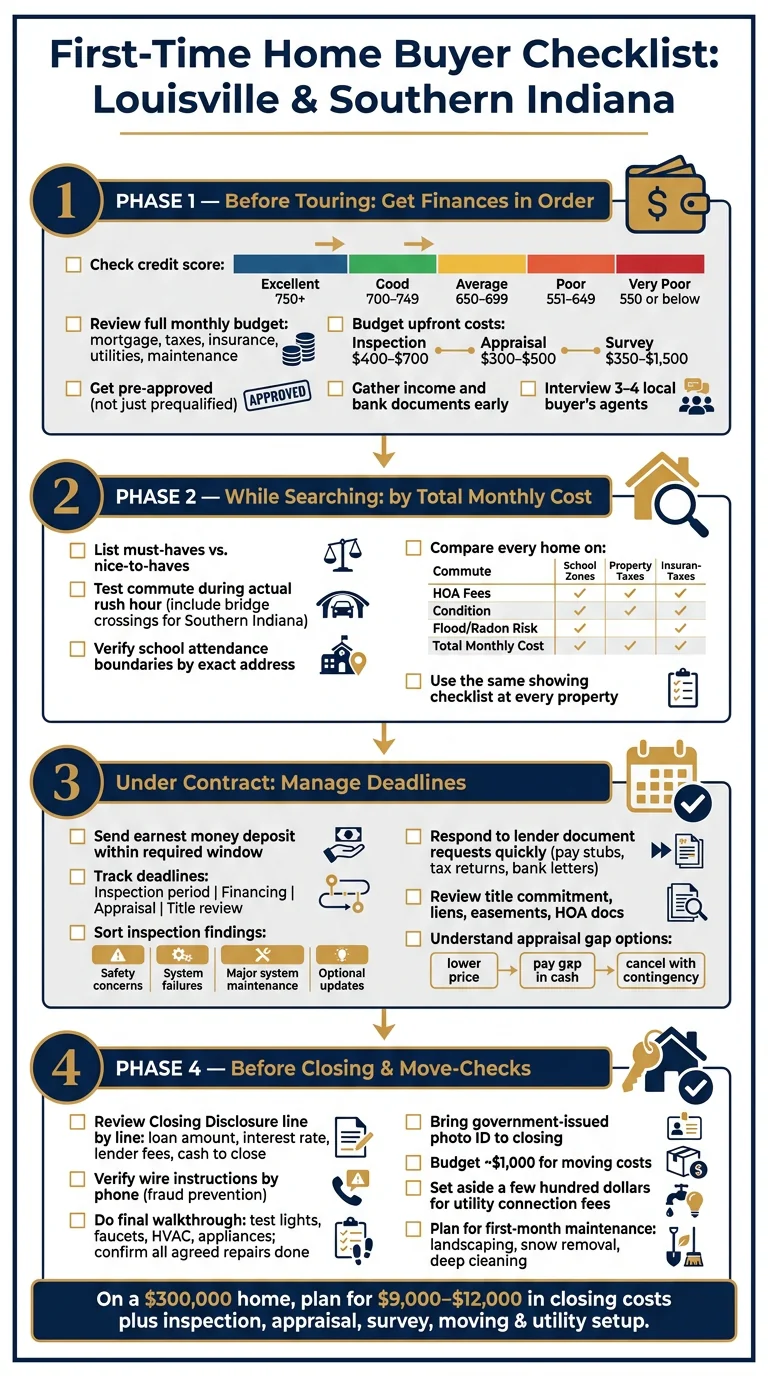
First-Time Home Buyer Checklist: Louisville & Southern Indiana
Before touring: get your finances in order and choose local help
Check your credit, savings, and monthly budget
Start with your credit. It shapes what kind of loan you can get and what interest rate you’re likely to pay. In most cases, credit scores fall into these ranges:
| Credit Category | Score Range | Mortgage Impact |
|---|---|---|
| Excellent | 750+ | Very high approval odds; best interest rates |
| Good | 700–749 | High approval odds; standard interest rates |
| Average | 650–699 | Good approval odds; slightly higher interest rates |
| Poor | 551–649 | Lower approval odds; high-risk borrower rates |
| Very Poor | 550 or below | Very low approval odds; may require non-traditional lenders |
If you’re buying with a partner, check both credit profiles as early as you can. Lenders review each borrower on their own, so one lower score can change the loan amount and the interest rate, even when the other borrower has a strong profile.
Then look at your full monthly housing budget, not just the mortgage payment. That means principal, interest, property taxes, homeowners insurance, utilities, and a backup fund for maintenance and surprise repairs. Lenders also look at your debt-to-income ratio to judge what you can afford.
You’ll also need cash for upfront costs beyond the down payment. Inspections, appraisal, and move-in expenses add up fast. Home inspections usually cost $400–$700, appraisals $300–$500, and a property survey $350–$1,500 if your lender asks for one. Once you’ve run those numbers, you can tour homes with a clear price range instead of guessing.
Get pre-approved and collect your documents early
Pre-approval comes before house tours, not after. It goes further than prequalification and gives you a better picture of what you can borrow. Lenders review your income, current debts, credit history, and whether you can cover the down payment and closing costs.
It helps to gather your paperwork early. You’ll want documents that prove your income and show where your down payment and closing-cost funds are coming from. That small bit of prep can save a lot of back-and-forth once you’re ready to make an offer.
If you might buy on either side of the Kentucky-Indiana state line, pay close attention to local costs. Taxes and closing fees can change by county and by state line.
Choose a buyer's agent who knows the Kentuckiana market
Pick your agent with care. A smart move is to interview three or four agents and ask how many homes they’ve helped clients buy or sell in the exact neighborhoods or communities you care about.
You should also ask about:
- Their preferred way to communicate
- How often they send new listings
- Their availability for showings
A good local agent should also be able to connect you with other pros in the area, like lenders, lawyers, movers, and contractors.
That matters even more in Kentuckiana. This cross-river market covers Louisville, Jeffersonville, New Albany, Clark County, Floyd County, Sellersburg, and nearby communities, so local know-how can make a big difference. Agent Intro matches buyers with one carefully selected local Realtor based on experience, availability, and working style across this area. If you already have someone in mind, the Second Opinion introduction gives you one human-reviewed alternative to consider before you commit.
With your numbers mapped out, your pre-approval in hand, and the right local agent lined up, you’re ready to start touring homes.
First-Time Kentucky Home Buyer Roadmap: Credit, Down Payment & Pre-Approval (2026)
While searching: compare homes by total fit, not just price
With pre-approval done and a local agent lined up, compare homes based on total monthly cost and how well each one fits your life day to day. List price matters, sure. But once you know your budget, the better question is: what will it cost to live there each month?
List your must-haves, deal breakers, and neighborhoods
Before you step into a single showing, write down what you need versus what would simply be nice to have. Think through bedrooms, bathrooms, layout, lot size, parking, and how much work you're willing to take on. Are you fine with paint and flooring, or would you also take on major system repairs?
Then tighten up your target neighborhoods. In Kentuckiana, location shapes more than just the vibe. It can change your commute, school boundaries, and monthly carrying costs. So when you compare areas, look at all three side by side.
Compare commute, schools, taxes, insurance, and property risks
Test the commute during actual rush hour, not on a quiet Sunday afternoon. If you're driving into or out of Southern Indiana, include bridge traffic in the mix. Those crossings can eat up more time than people expect during peak hours.
Check the attendance boundary for each exact address. Two homes on the same street can land in different zones, so verify the address early. And schools are only part of the picture. County property tax rates can differ too, and that can change your monthly payment.
Use the same scorecard for every house so you're not judging one home on emotion and another on numbers:
| Comparison Factor | What to Check |
|---|---|
| Commute | Peak-hour travel time, bridge crossings, distance to work and daily stops |
| School Boundaries | Verified attendance boundaries for the exact address |
| Property Taxes | County tax rate |
| Insurance | Homeowners insurance quote |
| HOA Fees | Monthly dues and what they cover |
| Condition | Age of major systems and visible upkeep issues |
| Risks | Flood exposure, drainage issues, radon potential, foundation concerns, septic or well systems |
| Total Monthly Cost | Mortgage + taxes + insurance + HOA + maintenance + utilities |
Flood exposure deserves extra attention in this region. Some homes in the Louisville area and Southern Indiana come with flood risk, and that can push insurance costs higher.
Use a showing checklist at every property
Bring the same checklist to every showing so each home gets judged on equal terms. At each stop, note the layout, accessibility, lot size, parking, renovation tolerance, included appliances, any boundary or easement issues, and visible repairs.
Air fresheners and candles can mask moisture, mold, or pet odors.
When you get home, run the numbers again using that property's actual tax rate, an insurance estimate, and a repair budget that reflects reality, not wishful thinking. Then rank the homes by total cost, not just by asking price.
If a home still makes sense after that pass, move it into your offer and inspection plan.
After an accepted offer: inspections, appraisal, and deadlines
After your offer is accepted, shift from shopping to deadline management. Once the seller says yes, the clock starts ticking on several dates that matter. Track each one closely so closing stays on schedule. The closing date is the final deadline, when funds are paid and possession changes hands.
Review offer terms, earnest money, and contingency deadlines
Start by reviewing the signed contract with your agent. Confirm the closing date, possession terms, and earnest-money instructions. Then send the deposit within the required window and save proof of payment.
Your contract also sets deadlines for the inspection period, financing, appraisal, and title work. Put each date on your calendar so a contingency deadline doesn’t slip past you.
Schedule inspections and sort findings before negotiating
Schedule your home inspection as soon as the contract is signed. When the report comes back, sort the findings into four buckets:
- Safety concerns
- Major system failures
- Deferred maintenance
- Optional updates
That makes it easier to decide what’s worth pushing on. Use the report to ask for repairs or credits tied to safety issues and major system problems. You can ask the seller to cut the price or finish repairs before closing.
Keep financing, appraisal, and title work on track
While inspections are moving, your lender will order the appraisal before closing to make sure the property value supports the loan amount. If the appraisal comes in below the purchase price, you usually have three paths: ask the seller to lower the price, pay the gap in cash, or cancel the contract if your offer includes an appraisal contingency.
Be ready if your lender asks for more paperwork. That might include updated pay stubs, tax returns, or letters explaining large bank deposits. Getting those in fast helps underwriting stay on track.
You’ll also need to review the title commitment, liens, easements, and HOA documents before your review deadline with your agent, lender, and closing attorney. This part may feel a bit dry, but it matters. A surprise lien or easement is the kind of thing you want to spot now, not after closing.
A property survey, if one is required, can cost $350 to $1,500 depending on the lot and location. Title insurance is a one-time fee that helps protect ownership.
| Process | Purpose | Who Orders | Primary Protection |
|---|---|---|---|
| Home Inspection | Evaluates physical condition and safety | Buyer | Buyer |
| Appraisal | Verifies market value for the loan | Lender | Lender |
| Property Survey | Confirms boundaries, improvements, and easements | Lender or Buyer | Both |
| Title Work | Ensures clear ownership and identifies liens | Lawyer/Title Co. | Both |
Once these items are done, move to cash-to-close review and final walkthrough prep. The next checklist covers cash to close and final move-in prep.
Before closing and move-in: final checks, cash to close, and move-in basics
Review the Closing Disclosure and avoid last-minute money mistakes
At this stage, the appraisal, title work, and financing are almost done. Now it's time to go through your final numbers line by line.
Check the loan amount, interest rate, monthly payment, lender fees, title charges, and cash to close - the amount you need to bring to settlement. Also look at prepaid interest and tax prorations tied to your closing date. Small line items can change the total, so this is not the moment to skim.
Before sending any money, verify wire instructions by phone using a number you confirmed on your own. That extra call can save you from a very expensive mistake.
Do the final walkthrough and prepare for closing day
The final walkthrough is your last chance to make sure the home is in the condition you agreed to buy. Bring your inspection repair addendum and check that every repair has been finished. Test the lights, faucets, HVAC, and major appliances. Make sure any items that were supposed to stay with the home are still there.
If you spot new damage or an unfinished repair, tell your agent right away. On closing day, bring a government-issued photo ID and double-check whether you'll need a cashier's check or a wire transfer.
Conclusion: your first-time buyer checklist for Kentuckiana
Before closing, confirm the final figures, then leave room in your budget for moving costs, utility hookups, and basic upkeep. Once the closing is done, your focus shifts fast to move-in tasks and first-month expenses.
A simple starting point:
- Budget about $1,000 for moving costs
- Set aside a few hundred dollars for utility connection fees
- Deep clean kitchens and bathrooms before furniture arrives
- Plan early for landscaping, snow removal, and routine maintenance
That last stretch comes down to final funds, final checks, and a smooth handoff into homeownership.
FAQs
How much cash should I save before buying my first home in Louisville?
Plan for two main upfront costs: your down payment and your closing costs. Closing costs usually land around 3% to 4% of the home’s purchase price. Your down payment, on the other hand, depends on your loan type and your financial profile.
Closing costs may include things like the home inspection, appraisal, and legal fees. While you’re getting pre-approval, ask your lender for an estimate based on your budget and the Louisville-area price range you’re looking at.
What monthly costs matter most besides the mortgage payment?
Besides the mortgage payment, the biggest monthly costs are property taxes and homeowners insurance. Those two expenses can have a big effect on your monthly housing budget.
If you put less than 20% down, you’ll also need to pay mortgage insurance. On top of that, set money aside for maintenance, utilities, and, if it applies to your home, condo association fees.
What deadlines can first-time buyers miss after an offer is accepted?
After an offer is accepted, first-time buyers often miss a few time-sensitive deadlines.
That can include:
- Paying the agreed earnest money fast, often within 24 hours
- Delivering earnest money within a short window, such as 48 hours
- Keeping mortgage paperwork moving so the lender can keep the loan on track for closing
It sounds simple, but this is where deals can start to wobble. Once the seller accepts your offer, the clock starts ticking almost right away. If you drag your feet on earnest money or lender documents, you can create delays that ripple through the whole closing process.
If you want a single, carefully considered introduction based on your goals — not a pile of cold calls — start a free Match Profile.
Ready for a thoughtful introduction?
Tell us about your move. Get one carefully selected introduction — free for buyers and sellers.
Find my agent ↗