
How to Choose the Right Realtor in Louisville
Define your move, confirm recent Louisville closings, test communication and offer strategy, and verify license and contract terms.
- Agent Selection
- Local Market
- Real Estate

There is no single best Realtor in Louisville. The right one is the agent who fits your move. If I were choosing, I’d focus on 4 things first: my deal type, the agent’s recent local closings, how they handle communication and offers, and the contract terms before I sign.
Here’s the short version:
- I’d define my move first: buying, selling, relocating, investing, upsizing, or downsizing
- I’d write down my budget in $USD, target areas, property type, and timeline
- I’d ask each agent for 3 to 5 recent closings in my area, price range, and deal type
- I’d test how they handle response times, showings, pricing, contingencies, and appraisal gaps
- I’d check their Kentucky license, outside reviews, references, and cancellation terms
- I’d avoid agents who give vague answers, push me to sign fast, or can’t explain fees clearly
A few details matter more than most people think. For example, timing can change the kind of agent I need: under 90 days, 3–6 months, or 6+ months. And if I’m comparing agents, I’d look for proof from the last 12 months, not just years in the business.
My goal wouldn’t be finding the most famous agent. It would be finding the one who fits my price range, neighborhood, and deal. That’s what helps cut missed details, slow replies, and weak offer or pricing choices.
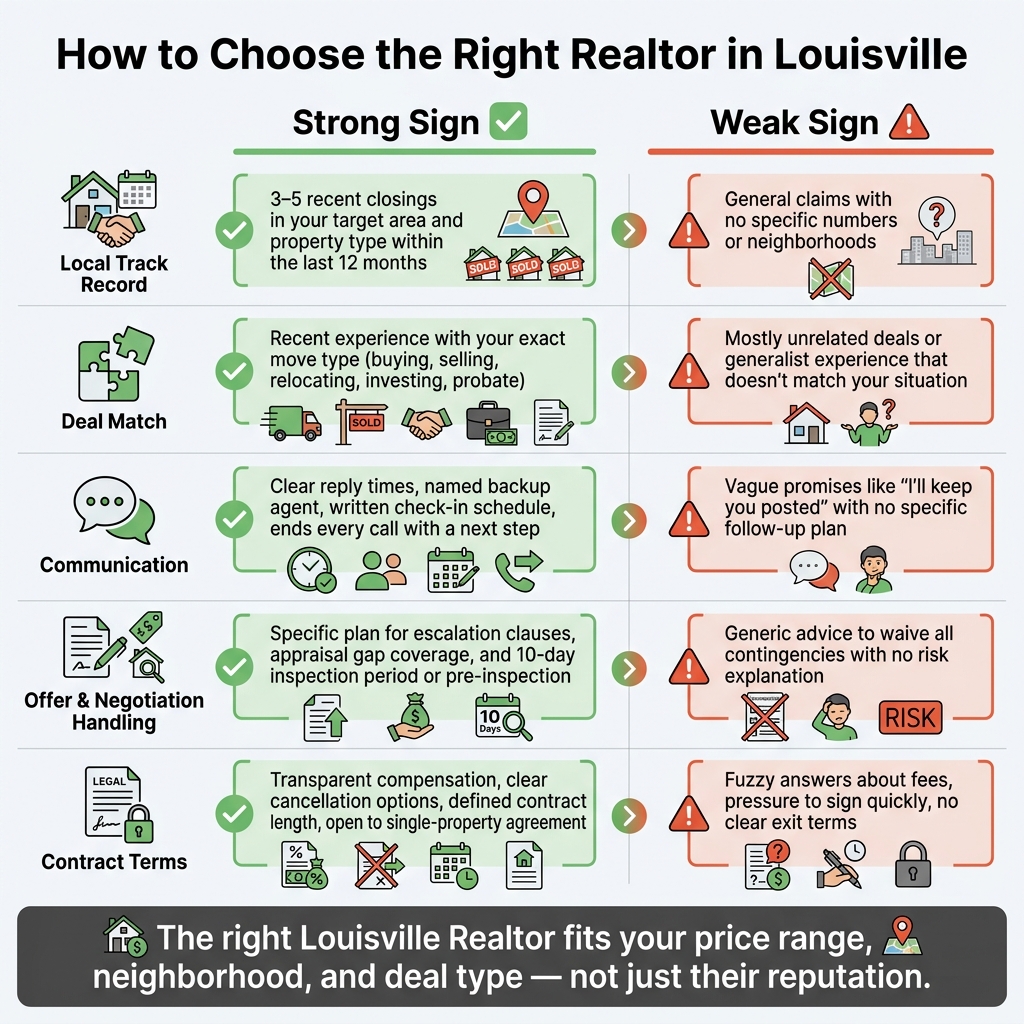
How to Choose the Right Realtor in Louisville: Strong vs. Weak Signs
Quick Comparison
| What I’d Check | Strong Sign | Weak Sign |
|---|---|---|
| Local track record | 3–5 recent closings in my area and property type | General claims with no numbers |
| Deal match | Recent work with my kind of move | Mostly unrelated deals |
| Communication | Clear reply times and next steps | “I’ll keep you posted” |
| Offer handling | Specific plan for contingencies and appraisal gaps | Generic advice or “waive everything” |
| Contract terms | Clear pay structure, length, and exit terms | Fuzzy answers or pressure to sign |
If I keep those points in front of me, choosing a Louisville Realtor gets much easier and much less stressful.
Define Your Louisville Real Estate Needs Before You Talk to Anyone
Figure out your move before you contact agents. If you skip that step, it's hard to compare people in any useful way. A clear move profile makes each conversation faster, sharper, and a lot less frustrating.
Write Down Your Transaction Type, Budget, Neighborhoods, and Timeline
Start simple. Write down your transaction type - buying, selling, relocating, upsizing, downsizing, or investing. Then add your target budget or expected list price in U.S. dollars, your preferred property type, and your target move date.
If you're open to areas beyond Louisville, note that too. That includes nearby Southern Indiana spots like Jeffersonville, New Albany, and Sellersburg.
| Field | Your Details |
|---|---|
| Transaction Type | Buying, Selling, Relocating, Upsizing, Downsizing, Investing |
| Target Budget/Price | $______________________ |
| Property Type | Single-family residence (SFR), condo, townhome, multi-unit |
| Preferred Areas | Louisville neighborhoods and/or nearby Southern Indiana communities |
| Target Move Date | ______________________ |
It also helps to sort your timing into one of three buckets:
- Under 90 days
- 3–6 months
- 6+ months
That small detail matters. It helps you screen out agents who may already be overloaded.
Once your move profile is clear, you can judge agents on fit, not just name recognition.
Buyer Priorities vs. Seller Priorities
Buyers and sellers usually need very different things from an agent. A buyer in a competitive market may need help finding off-market homes, moving fast on offers, and handling inspection terms without losing the deal. A seller, on the other hand, usually needs help with pricing, marketing, and sorting through offers with a clear head.
| Priority Area | Buyer Focus | Seller Focus |
|---|---|---|
| Primary Goal | Sourcing inventory and winning offers | Maximizing net proceeds and closing certainty |
| Key Tool | Off-market and "Coming Soon" listings | Comparative Market Analysis (CMA) and pricing strategy |
| Critical Skill | Offer architecture - escalation clauses, appraisal gap coverage | Professional photography, staging, and marketing syndication |
| Due Diligence | Shortened inspection and loan contingency windows | Evaluating buyer financing credibility |
| Communication | Immediate availability for showings and fast offer turnaround | Regular showing feedback and market trend updates |
That gap between buyer needs and seller needs shapes the questions you should ask.
The next step is to check whether an agent has recent experience with deals like yours. With your move profile in hand, you can compare agents based on local fit and recent results instead of guesswork.
How to Judge a Realtor's Local Experience and Transaction Fit
Once you know what kind of move you're making, the next step is simple: check whether the agent has recent closings that line up with it.
Time in the business matters less than the deals they've closed lately. What matters is whether the agent has worked in your target neighborhoods, at your price range, and with your kind of deal - buying or selling.
Review Recent Work in Your Target Area and Property Category
A good baseline is three to five recent closings in your target area and property type on the buyer or seller side, based on your move. That kind of activity suggests the agent knows the local pace of competition, which neighborhoods move faster, how buyers and sellers react to terms versus price, and how lot size and shape can change value. Before you hire anyone, ask for MLS transaction history that matches your price range and neighborhood goals.
This part matters more than many buyers and sellers think. An agent who mostly works standard resales may not be the right fit if you're buying an investment property, moving from out of town, dealing with probate, or selling a type of home they rarely list. Ask whether they've handled your exact situation lately, then have them walk you through one actual example.
If off-market deals matter to you, ask how they find homes before they hit the market. Good answers should name specific channels, like agent-to-agent networks, probate relationships, direct seller outreach, or Coming Soon MLS status. The best agents don't just set MLS alerts and wait. They go out and find chances before a listing goes live. In Louisville's competitive submarkets, that can mean faster access, more choices, and better offer strategy for buyers. For sellers, it can mean pre-market interest before the home is publicly listed.
Questions to Ask About Comparable Transactions
The point of these questions is to tell the difference between specific local knowledge and plain confidence. Ask things like:
- "How many closings have you completed in [Target Neighborhood] in the past 12 months?"
- "What is the current list-to-sale ratio for [Property Type] in this specific zip code?"
- "What inspection and financing contingencies do you recommend for a [Year/Style] home here right now?"
- "Which local lenders do you recommend, and why are they respected by listing agents in this area?"
Strong Evidence vs. Weak Evidence: A Comparison Table
Use this table to compare what agents say with what actually shows local fit.
| Evaluation Area | Strong Evidence | Weak Evidence |
|---|---|---|
| Neighborhood Experience | 3–5 specific closings in your target area in the last 12 months; knowledge of street-by-street trends | Vague claims of "covering all of Louisville" with no specific numbers |
| Recent Transactions | MLS history that matches your price range and property type | References to "many years in the business" or general sales volume |
| Transaction Fit | Recent work with your specific move type, such as relocation, probate, investment, or a comparable listing | Generalist experience that doesn't match your situation |
| Off-Market Access | Can describe the exact channel used for a recent off-market or pre-listing home | Says they "know people" but can't give a concrete example |
| Pricing and Contingency Advice | Nuanced guidance on inspection periods and appraisal gap coverage based on current competition | Generic advice to "waive everything" without context |
Once local fit is clear, the next thing to check is how the agent communicates and handles offers.
What to Ask Realtors About Communication, Availability, and Negotiation
After local fit, communication and negotiation are what shape the deal. They can be the difference between getting terms that work for you and scrambling at the last minute. Once you've confirmed that an agent knows your market, the next step is simple: compare how each one communicates and how each one handles pressure. If you're interviewing two or three agents, pay close attention to how specific their answers are.
Ask About Response Time, Direct Access, and Scheduling
Start with the most practical question: who are you actually working with?
Ask this directly: "Will I be working with you, or will showings and deadlines be handled by an assistant or junior partner?"
That one question can tell you a lot. Some agents stay closely involved. Others pass key parts of the job to someone else. That's not always a deal-breaker, but you need to know it upfront.
Then ask for a clear offer turnaround time. A good answer includes a specific timeline for putting together a complete offer package. If the reply is fuzzy or full of general promises, that's a red flag - especially in a market where homes move fast. You should also ask what happens if the agent is unavailable. A good agent should be able to name a backup who already knows your file.
If you're selling, ask for a written communication plan. Strong agents set a clear schedule for check-ins and showing feedback, so you know when you'll hear from them and what comes next after each showing.
Speed matters. But when you're talking about price, offers, and terms, a smart plan matters even more.
Ask How the Agent Handles Pricing, Offers, and Problems
This is where you find out whether an agent has a real plan or is just winging it.
Ask them to walk you through how they'd handle a multiple-offer situation for a specific property type in your target Louisville neighborhood and price range. A good answer should include details about offer structure - like escalation clauses, appraisal gap coverage, and shorter contingency windows - not just a generic "offer over asking" line.
When the topic turns to contingencies, dig a little deeper. This is often where weak agents expose you to risk you didn't need to take. A skilled agent shouldn't push you to waive everything. Instead, they might suggest a 10-day inspection period or a pre-inspection so you stay competitive without taking on extra risk. You should also ask how they handle appraisal gaps and how they estimate those gaps before you submit a bid.
Strong Fit vs. Weak Fit: A Comparison Table
Use this table after your interviews. It helps you spot the gap between agents who offer a real plan and agents who mostly offer reassurance.
| Area | Strong Fit | Weak Fit |
|---|---|---|
| Offer Speed | Names a clear turnaround time for a complete offer package | Takes 24–48 hours; can't name a specific turnaround time |
| Contingency Advice | Recommends a 10-day inspection period or a pre-inspection | Tells you to waive all contingencies with no risk explanation |
| Appraisal Gap | Can estimate the likely gap before you bid using CMA data | Suggests a high offer with no plan if the appraisal comes in low |
| Communication | Sets a clear check-in and feedback schedule; ends every conversation with a specific next step and timeline | Vague promises like "I'll keep you posted" with no clear follow-up |
| Direct Access | You reach the lead agent directly for showings and deadlines | Urgent matters get routed to an assistant or junior team member |
Check Credentials, Reviews, and Agreement Terms Before You Decide
Once you've compared local fit, communication style, and negotiation approach, take one more step before choosing: check the license, the reviews, and the agreement terms.
Start with the basics. Verify that the agent has an active Kentucky license. You can also check for disciplinary actions or complaints through the Kentucky Real Estate Commission (KREC). If you're seriously thinking about hiring someone, they should be willing to share their license number and references without hesitation. If they dodge that request, that's a red flag.
Then move to reviews on outside platforms like Google Business or Zillow, not just the glowing quotes on the agent's own site. You're not looking for a perfect 5-star profile. You're looking for patterns. Do several people mention slow follow-up, poor communication, or an agent who vanished after the contract was signed? Or do reviewers share clear, specific results instead of vague compliments?
References matter too. Ask for them, then actually make the calls. A simple question can tell you a lot:
How did the agent handle a problem in the middle of the transaction?
If an agent makes specific claims about performance, check those claims against MLS transaction history before you hire them.
Before signing anything, go over the agreement terms line by line. Buyers now need to sign a written representation agreement before touring homes. Make sure you know how compensation works, who pays what, how long the contract lasts, and what your cancellation options are. Many agents ask for 90-day exclusive agreements, but both the length and the exclusivity can be negotiated.
If you're still unsure, ask about a single-property agreement. That gives you a way to test the agent on one home or one showing before making a longer commitment. It also helps you see how they communicate and whether they actually follow through. And one more thing: confirm in writing whether you'll be working with the lead agent or a transaction coordinator, since that person may handle the day-to-day paperwork.
Red Flags to Watch for Before Signing
Pressure is a bad sign. If someone pushes you to sign right away, slow down.
Watch for issues like these:
- An inactive or restricted license
- Vague answers about compensation
- No clear cancellation terms
- Pushback when you ask for references or license details
If you run into serious conduct concerns, you can report them through the Kentucky Real Estate Commission (KREC).
Use a Final Scorecard and Consider an Agent Intro Match
At this stage, it helps to use the same interview criteria one last time and compare agents side by side. A simple scorecard can keep the choice grounded in facts instead of gut feeling alone.
| Evaluation Area | What to Look For |
|---|---|
| License Status | Active Kentucky license with no disciplinary actions or complaints |
| Review Patterns | Consistent responsiveness and follow-through across independent platforms |
| References | Specific examples of how the agent handled problems mid-transaction |
| Agreement Terms | Transparent compensation, clear cancellation options, and a defined duration |
Pick the agent who scores highest on fit, follow-through, and contract clarity.
Conclusion: Choose the Realtor Who Fits Your Specific Move
The right Realtor isn't the one with the most yard signs or the biggest social following. It's the one whose experience, availability, and working style line up with your move in Louisville.
Start by defining what you need. Then compare local and deal-specific experience, interview for communication and negotiation fit, and check credentials and agreement terms before you sign. That puts you in a much better spot to choose with confidence.
FAQs
How many Realtors should I interview?
Interview 3 to 5 Realtors. That’s usually enough to compare fit without turning the search into a long, drawn-out project.
Pay close attention to how each agent talks about:
- local neighborhood knowledge
- recent, relevant transactions
- communication and availability
- negotiation style
- pricing and overall approach
In Louisville, the best answers should tie back to your goals, not just generic sales talk. You should also hear about documented transactions from the last 12 months that you can check for yourself.
Can I switch Realtors if the fit feels wrong?
Yes. Buying or selling a home is a big money decision, and it’s personal too. That’s why it matters to work with a Realtor who matches your communication style, goals, and what you need from the process.
If the relationship isn’t working, you don’t have to stick with it. Before you sign a long-term exclusive agreement, it can make sense to start with a single-property limited agreement first. That gives you a chance to test the fit without going all in.
What if I’m buying or selling on a tight timeline?
Prioritize speed and a clear plan. Pick an agent who communicates fast, can turn your decision into a full offer without delay, and lays out each step from the first appointment through closing.
If you're buying, ask how fast they can put together a clean offer and manage contingencies. If you're selling, ask what pricing and marketing steps they’ll handle right away, including CMA comps and the next milestones.
Ready for a thoughtful introduction?
Tell us about your move. Get one carefully selected introduction — free for buyers and sellers.
Find my agent ↗