
Making an Offer in Louisville: Step-by-Step Guide
Set your budget, use comps to pick a price, write clear contract terms, handle inspections and appraisals, and prepare for closing in Louisville.
- Agent Selection
- Local Market
- Real Estate
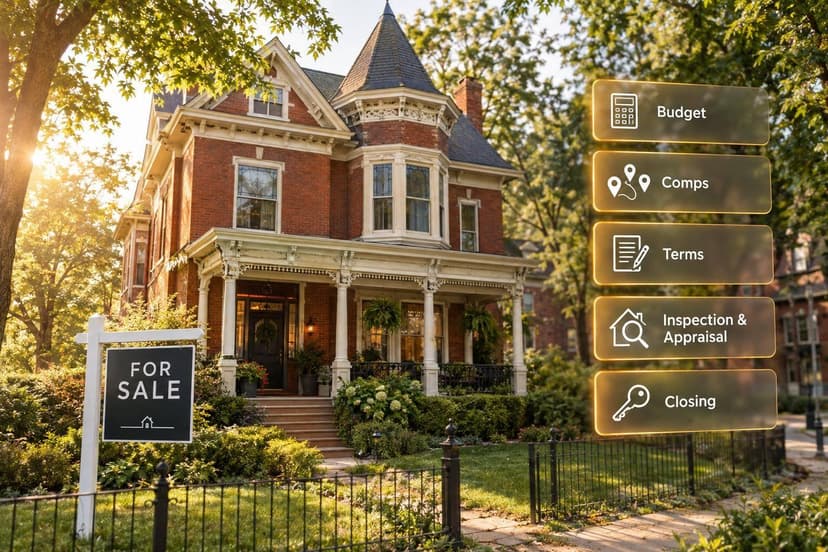
To make an offer in Louisville, set your budget, use recent sales to choose a price, and put your terms in writing. My advice: keep cash for repairs and closing costs - not just the down payment.
Here’s the process I’d follow with a local buyer’s Realtor:
- Write the offer: Set the price, earnest money, financing, contingencies, closing date, and possession terms.
- Review counteroffers: Check every change against your budget before signing.
- Handle inspection and appraisal issues: Review repair costs, lender rules, and your contract rights before agreeing to changes.
- Prepare for closing: Finish loan requirements, verify wiring instructions by phone, and check the home before taking possession.
A $300,000 offer with a $290,000 appraisal leaves a $10,000 valuation gap - but your lender must calculate how that affects your cash needs.
My rule throughout: <u>follow the signed contract, track each deadline, and get changes in writing.</u>
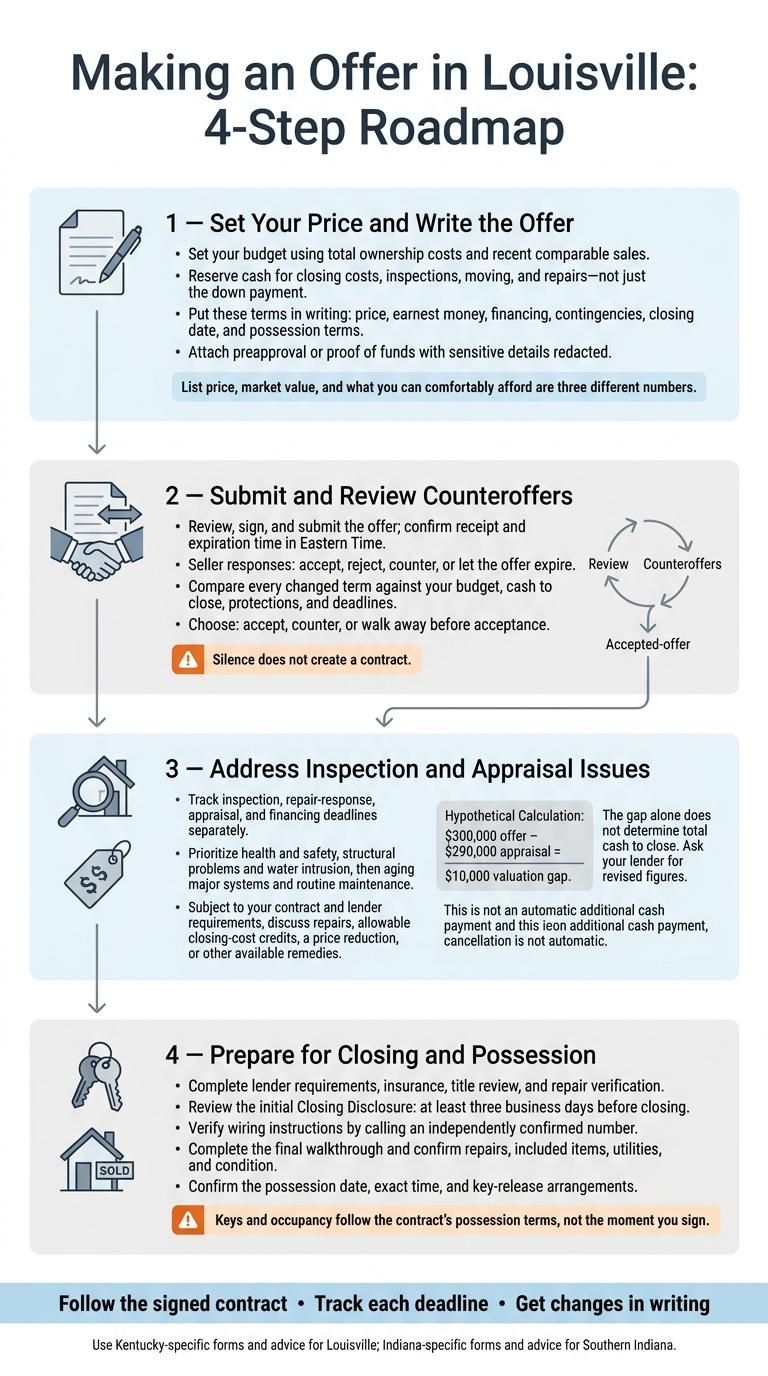
Making an Offer in Louisville: 4-Step Roadmap
Step 1: Set Your Price and Write the Offer
Set Your Limit Using Your Budget and Comparable Sales
List price, market value, and what you can comfortably afford are three different numbers. The asking price is a starting point - not proof of value. Use your preapproval as a cap, then work out your costs: principal, interest, taxes, insurance, mortgage insurance, HOA dues, utilities, maintenance, closing costs, and reserves.
Keep cash available for the down payment, prepaid expenses, inspections, moving, and repairs. Before making an offer, decide how much extra you could spend if inspections reveal problems or the appraisal comes in low.
Ask for a comparative market analysis (CMA) that puts the most weight on recent closed sales of similar homes. Also review active listings, pending sales, price reductions, days on market, and other offers. Instead of simply averaging prices, account for differences in condition, size, lot, garage, and renovations.
Local comparisons matter. Louisville prices vary by neighborhood and condition.
In the Highlands, compare older homes in the same micro-area and condition range. In eastern Jefferson County, compare similar subdivisions, garages, lots, and HOA dues. For Southern Indiana, use nearby Indiana sales and verify taxes, insurance, and closing costs separately.
Use that budget ceiling and sales data to choose your price and terms.
Choose Your Offer Price and Earnest Money
| Offer approach | Price approach | Why it works | Cash needed | Negotiation risk |
|---|---|---|---|---|
| Below list | Discount backed by condition, comparable sales, or time on market | Stronger when seller interest is limited | May lower purchase costs; repairs still need funding | Rejection or counteroffer |
| Market-aligned | Near supported value, regardless of asking price | Grounds the offer in sales data | Depends on financing, credits, and prepaid expenses | Other terms may decide acceptance |
| More competitive | Higher price or seller-friendly terms backed by competition | Offers the seller more certainty or convenience | May require a larger down payment or cash to cover a low appraisal | Overpaying or exceeding your budget |
Above list doesn't necessarily mean above market value. And price alone doesn't tell you how much cash you'll need.
Earnest money is a negotiated good-faith deposit. It's usually credited toward your closing funds, not charged as an extra fee. Put the amount, payment deadline, holder, and refund and release conditions in writing. Confirm when to deliver it and keep proof of payment.
Don't assume the deposit will be refunded. Contract terms, notices, deadlines, and any buyer default affect whether you get it back or put it at risk.
Put the Terms and Contingencies in Writing
Put the agreed numbers and terms into the contract: price, financing type, down payment, earnest money, closing date, and a separate possession date. Identify which appliances, fixtures, security devices, and leased equipment stay - and which don't.
Specify seller credits, required addenda, notice delivery methods, and an offer expiration date with an exact time and time zone. Attach preapproval or proof of funds, but redact account numbers, Social Security numbers, and other sensitive details. Check that any seller credit falls within lender limits.
Contingencies spell out your protections. A financing contingency covers loan approval. An appraisal contingency addresses a low appraisal, while an inspection contingency sets inspection rights and remedies. A home-sale contingency makes the purchase depend on selling your current home.
Clearly state inspection periods, response deadlines, repair limits, and written-notice requirements. For older Louisville homes, include roof, HVAC, sewer, electrical, and radon checks - not just a general inspection. Define the available remedies, such as repair requests, credits, price changes, or termination. Record any agreements in signed amendments.
Have your Realtor review the completed Kentucky forms, and ask a Kentucky real estate attorney to interpret legal questions. Across the river, use Indiana-specific forms and advice.
Once you sign and send the offer, the seller can accept it, reject it, or counter specific terms.
Step 2: Submit the Offer and Review Counteroffers
Review, Sign, and Submit the Offer
Stick to the budget and protections you set before drafting the offer. Before signing, check the property address, price, earnest money, financing, closing and possession dates, expiration time, included items, contingencies, repair requests, and addenda.
Send the signed offer packet and any requested preapproval or proof of funds to the listing agent through the agreed channel. Ask for written confirmation of receipt, the delivery time, and the expiration deadline in Eastern Time. Keep a copy of everything you submit.
The seller can accept, reject, counter, or let the offer expire. Silence does not create a contract. Acceptance must be written, signed, and delivered before the deadline. A counteroffer replaces the prior terms unless both parties agree otherwise in writing. If the deadline passes without acceptance, treat the offer as expired unless it’s properly extended or revived in writing.
Review Every Changed Term
Before responding to a counteroffer, check what changed. Each change can affect your cash to close, schedule, or risk.
Compare the terms line by line: price, seller credits, earnest money, financing, included property, repairs, closing, possession, and every deadline. Mark each contingency as unchanged, modified, or removed. Ask your lender for updated payment and cash-to-close figures whenever the price, seller credit, rate assumptions, loan type, or closing date changes.
Make sure shorter inspection or loan-approval periods leave enough time before you agree. Put every negotiated change in a signed contract or addendum; verbal promises don’t count. Confirm that all required parties sign the same final version.
Decide Whether to Accept, Counter, or Walk Away
| Choice | Financial impact | Timing | Contract risk |
|---|---|---|---|
| Accept | Confirm funds and deadlines first | Sign and deliver before expiration | Accepted terms become binding |
| Counter | Seek better costs or protections | Allow another negotiation round | Prior terms may no longer be available |
| Walk away | Avoid terms beyond your limit | Stop before acceptance | Not the same as terminating a contract |
Ask your Realtor what’s known about competing offers and the seller’s priorities, such as moving time or financing certainty. A closing date that works for the seller may help without increasing your price. But don’t give up a protection just because you feel rushed.
Declining a counteroffer is different from terminating an accepted contract. Once you’re bound, follow the contract’s notice requirements and deadlines.
After acceptance, save the executed agreement and add the deadlines to your calendar. Next come inspection and appraisal deadlines - and any negotiations prompted by those findings.
Step 3: Address Inspection and Appraisal Issues
Once the seller accepts your offer, your focus shifts from price negotiations to deadlines. Track earnest money, inspections, repair responses, appraisal, financing, and lender-required repairs separately. For example, the Kentucky REALTORS residential sales contract may require earnest money within three days and a written response to a low appraisal within five days. Your signed contract controls.
Extending one deadline doesn't automatically extend the others. Put every change in a signed amendment - missing a deadline can cost you contractual rights. Start by scheduling the inspection.
Sort Inspection Findings by Priority
Schedule the general inspection promptly, leaving time for any specialist inspections you may need, such as sewer, radon, termite, structural, or moisture evaluations. A general inspection checks observable conditions. It can't find every hidden defect or guarantee that the seller will make repairs.
Address health and safety hazards first, followed by structural problems and water intrusion, aging major systems, and routine maintenance or cosmetic issues. If a Louisville home has basement moisture, get a qualified assessment. Treat it as a water issue, not a cosmetic flaw.
Hypothetical Louisville sewer concern: A sewer-scope inspection identifies root intrusion or a damaged lateral. Get the video, written findings, and a licensed plumber’s estimate that distinguishes spot repair, lining, excavation, or replacement. If the seller agrees to work, put the affected section, remedy, materials, contractor expectations, completion date, and any permit requirement in writing. Before closing, ask for paid receipts, warranty information, and a follow-up scope or other verification. The inspection report alone does not obligate the seller to repair the line, and a home warranty is only a supplement - not a substitute for fixing a known sewer defect.
Focus your requests on habitability, insurability, financing, future damage risk, and major costs. Your contract - not the inspection report - determines your remedies. Use those terms to decide whether to request repairs, credits, or a price reduction.
Negotiate Repairs, Credits, or a Price Reduction
Base your request on repair urgency, available cash, and lender requirements. A closing-cost credit preserves cash for repairs; a price reduction doesn't put repair money in your pocket. Before accepting a credit, ask your lender to confirm that your loan program permits it and that it covers only allowed closing costs. Some property corrections may still need to be completed before closing.
| Option | Buyer cash impact | Lender considerations | Completion risk |
|---|---|---|---|
| Seller repairs | Reduces immediate repair spending | Must satisfy any required corrections | Verify quality and completion |
| Closing-cost credit | Preserves cash for later work | Limited to allowed amounts and costs | The defect remains until repaired |
| Price reduction | Lowers the purchase price | Revised loan calculations apply | Buyer funds and manages the work |
| Home warranty | May help with some covered breakdowns | Does not replace required corrections | Exclusions, fees, and caps apply |
| Proceed unchanged | Buyer bears the repair cost | Existing requirements still apply | Buyer accepts the condition risk |
If the appraisal comes in low, shift the discussion to options based on the home's appraised value.
Review Your Options After a Low Appraisal
Hypothetical Louisville purchase: A $300,000 contract appraises at $290,000, creating a $10,000 valuation gap. An appraisal supports the lender’s valuation; it does not replace a condition inspection. Your options may include asking for a lower price or allowable credit, bringing additional cash if the lender allows it, requesting a reconsideration of value through your lender, or using the appraisal contingency if your contract provides one. The seller does not have to agree. Ask your lender for revised figures, because the gap alone does not determine total cash to close; the final amount also depends on the down payment, loan-to-value ratio, closing costs, prepaids, and credits. Cancellation rights and earnest-money treatment depend on your contract and timely written notice, not just on receiving a low appraisal.
Step 4: Prepare for Closing and Possession
Track Deposits, Loan Approval, and Repairs
Once price and appraisal issues are settled, focus on lender conditions and closing logistics. An accepted offer still depends on lender approval. Protect your financing and funds by tracking each deadline: earnest money, loan conditions and documents, appraisal, title, insurance, repairs, Closing Disclosure delivery, closing, and possession. Send earnest money to the recipient named in your contract by the deadline, and keep the receipt.
Send requested income, asset, and gift-fund records promptly. Ask which underwriting conditions remain - a completed appraisal doesn’t mean your loan has final approval. Arrange homeowners insurance and confirm that your lender received the policy information.
Check with your lender before changing jobs, moving large sums of money, opening or closing credit accounts, or financing purchases. Keep paid repair invoices, warranties, and required permits. If repairs or approval run late, get a signed extension before the affected deadline expires.
Confirm Closing Funds and Possession
Your lender must deliver the initial Closing Disclosure at least three business days before closing. Compare its loan terms, payment, fees, taxes, insurance, earnest-money credit, seller credits, and cash to close against your contract and Loan Estimate. Contact the lender immediately if the disclosure arrives late or contains errors. Certain major changes - an inaccurate APR, a changed loan product, or a newly added prepayment penalty - can trigger a new waiting period.
Once the numbers check out, turn to title, wiring, and the final walkthrough.
Confirm who handles the title search, title insurance, deed preparation, settlement, recording, and disbursement. These duties differ between Kentucky and Southern Indiana. Resolve questions about liens, easements, and title exceptions before signing.
Confirm the closing location, time in Eastern Time, required photo ID, insurance documents, and accepted payment method. Verify wiring instructions by calling an independently confirmed number, never one found only in an unexpected email. Confirm the account details and amount before sending funds, then verify receipt.
Schedule the final walkthrough shortly before closing, ideally after move-out. Check that repairs are complete, included appliances remain, utilities work, and no new damage has occurred. Bring repair agreements and records. Photograph unresolved problems and contact your Realtor and settlement professional before signing off on the walkthrough.
Review the contract’s possession date and exact time, who releases the keys, and any post-closing occupancy agreement. Keys and occupancy follow the contract’s possession terms, not the moment you sign.
Conclusion: Stay Within Budget and Meet Your Deadlines
Stick to your budget through every counteroffer and amendment. Before you sign, set aside cash for repairs, moving, and emergencies.
Protect your terms through closing: put changes in writing and add inspection and appraisal deadlines to your calendar.
If a change affects money, timing, or possession, get it in writing before you agree.
FAQs
How can I strengthen my Louisville offer without raising the price?
Give the seller confidence that the deal will close. Shorter contingency windows, like a 10-day inspection period or a 14-day loan approval deadline, can show you're ready to move forward.
If the seller needs extra time to move, a rent-back period after closing can be just as persuasive as a higher price. Working with a reputable local lender can also help reassure the listing agent about your financing and closing timeline.
Can I withdraw my offer before the seller accepts?
You can generally withdraw your offer before the seller signs and delivers formal acceptance. Once the seller formally accepts in writing, your offer becomes a legally binding contract.
After that, whether you can cancel without penalty depends on your contract’s contingencies, such as inspection, financing, or appraisal.
Review your offer documents with your real estate agent so you understand the terms and deadlines for withdrawing or canceling.
What if agreed repairs aren’t finished by closing?
If your final walkthrough reveals that agreed-upon repairs aren’t finished, notify your real estate agent immediately. This is your last chance to check the home’s condition before closing. Address any issues before signing the final paperwork - not after closing.
Work with your agent to document the next steps in writing and confirm that the home meets the agreed-upon standards before moving forward with closing.
Ready for a thoughtful introduction?
Tell us about your move. Get one carefully selected introduction. No obligation to hire.
Find my agent ↗