
Southern Indiana vs Louisville: Household Budget
Compare total monthly housing, taxes, utilities, and commute costs to decide if Louisville or Southern Indiana fits your budget.
- Agent Selection
- Local Market
- Real Estate

A cheaper home doesn’t always mean a cheaper month. I’d compare Louisville, Jeffersonville, Clarksville, and New Albany using the same household budget first. For a downtown Louisville commute, tolls alone can add about $121 a month with a qualifying transponder at five office days per week.
Here’s what I’d count before choosing a side of the river:
- Housing: Mortgage or rent, property taxes, insurance, flood coverage, HOA fees, and repairs.
- Taxes: State and county income taxes, Louisville work taxes, and sales taxes.
- Utilities: Electricity, heating, water, sewer, trash, and internet.
- Travel and family costs: Fuel, tolls, parking, vehicle upkeep, child care, and school trips.
- Cash needs: Moving costs, deposits, closing costs, and emergency savings.
Quick Comparison
October 2026 average rents offer a starting point - not quotes for comparable three-bedroom homes.
| Budget check | Louisville | Jeffersonville | Clarksville | New Albany |
|---|---|---|---|---|
| Average monthly rent | $1,330 | $1,366 | $1,156 | $1,194 |
| Property-tax check | Parcel assessment and taxing districts | Indiana homestead rules | Indiana homestead rules | Indiana homestead rules |
| County income-tax check | Louisville work taxes | Clark County | Clark County | Floyd County |
| Downtown commute | Check miles and parking | Compare tolled and toll-free routes | Compare tolled and toll-free routes | Compare tolled and toll-free routes |
My rule: compare <u>the total monthly cost at each address</u>, then test three versus five office days and one versus two cars. Use property-specific quotes and bills before deciding which location fits your budget.
Compare Housing Payments, Property Taxes, and Insurance
Mortgage Payments and 3-Bedroom Rents
Your mortgage or rent payment is just one part of your housing budget. Compare three-bedroom rents and purchase prices for specific properties. Generic figures won’t give you reliable city totals. Use the same cost categories for each market.
| Housing expense | Monthly budget treatment | Annual/upfront treatment |
|---|---|---|
| Principal and interest | Calculate using the lender’s rate and loan terms | Monthly payment × 12 |
| Private mortgage insurance | Use the lender’s quote if required; generally applies below 20% down | Monthly premium × 12 |
| HOA dues | Use actual dues rather than assuming $0 | Include annual dues and separate special assessments |
| Maintenance | Set aside a property-specific reserve for the roof, HVAC, and inspection findings | Monthly reserve × 12 |
| Three-bedroom rent | Include advertised rent and mandatory recurring fees | Monthly charges × 12; keep deposits separate |
Keep closing costs, inspections, and prepaid escrows out of recurring totals. For rentals, check lease incentives, pet charges, parking costs, and which utilities are included.
Compare homes with similar construction ages and features. Newer homes may need fewer near-term repairs, while larger homes can cost more to heat, maintain, and insure. An asking price isn’t a closed-sale price - and neither tells you the mortgage payment.
A lower payment can come with higher taxes, insurance, or upkeep. Once you’ve calculated the housing payment, compare property taxes on both sides of the river.
Indiana Homestead Tax Caps vs. Louisville Property Taxes
Indiana’s 1% homestead cap usually applies to qualifying owner-occupied homes. Other residential property usually falls under the 2% cap. Deductions, credits, and voter-approved referenda can change the final bill. The caps use gross assessed value before deductions, credits, and referendum charges.
| Tax treatment | Annual amount | Monthly equivalent |
|---|---|---|
| Indiana homestead at $300,000 gross assessed value | $3,000 cap | $250 |
| Indiana other residential property at the same value | $6,000 cap | $500 |
| Louisville property | Requires the parcel’s assessment, exemptions, and all applicable taxing districts | Annual tax estimate ÷ 12 |
The Indiana figures show caps, not verified bills. Louisville’s FY 2026–2027 Metro rate is 11.64 cents per $100 of assessed value, plus 32.76 cents within the Urban Services District. The parcel’s assessment, exemptions, and taxing districts still determine the final bill.
Get local parcel records for each property, and keep the current owner’s bill separate from the buyer’s estimate. That distinction matters when exemptions or assessments may change. Income and sales taxes tied to work location also belong in the comparison after housing costs.
Homeowners and Flood Insurance Costs
Compare insurance quotes for each address, not city averages. Replacement cost, roof condition, age, claims history, and deductibles affect premiums. Standard homeowners policies don’t cover flood damage.
Check FEMA maps and lender rules separately, and get quotes before adding insurance to either location’s total.
| Coverage | Match between properties | Budget treatment |
|---|---|---|
| Homeowners | Dwelling replacement cost, contents, liability, and loss-of-use limits | Annual quoted premium ÷ 12 |
| Deductibles and endorsements | Wind/hail deductible, water backup, and roof settlement terms | Keep potential out-of-pocket costs separate |
| Flood | Building and contents limits, deductible, and lender requirements | Separate annual premium and monthly equivalent |
Include insurance in the monthly total using each property’s quote; the address matters more than the city name.
Next, compare income and sales taxes based on where each household member lives and works.
Compare Taxes Where You Live and Work
State, County, Louisville, and Sales Tax Rates
Separate the taxes tied to where you live, work, and shop. Indiana–Kentucky reciprocity generally lets residents report covered wages to their home state instead of paying income tax to both states. But it does not automatically remove county or Louisville occupational taxes.
Where you physically work - not just your employer’s address - can also affect what you owe. For hybrid households, days worked in Louisville can change both taxes and commuting costs.
| Tax | Rate | What it applies to |
|---|---|---|
| Indiana state income tax | 2.95% for 2026 | Indiana adjusted gross income. |
| Clark County income tax | 2.00% | County taxable income under Indiana residency rules; listed for withholding beginning October 1, 2026. |
| Floyd County income tax | 1.89% | County taxable income under Indiana residency rules; listed for withholding beginning October 1, 2026. |
| Kentucky state income tax | Confirm 2026 rate | Kentucky taxable income, with reciprocity for qualifying Indiana residents’ wages. |
| Louisville occupational tax | Confirm resident and nonresident rates | Louisville earnings, based on which days are worked in Louisville. |
| Kentucky sales/use tax | 6% | Taxable purchases. |
| Indiana sales/use tax | Confirm current rate | Taxable purchases and applicable use-tax obligations. |
For $2,000 in monthly taxable purchases, Kentucky’s 6% rate produces $120 per month, or $1,440 per year.
Apply sales tax only to taxable purchases, leaving out exempt items and services. Cross-river and online purchases can also trigger use-tax obligations. Buying elsewhere does not necessarily mean avoiding the tax.
Tax Costs for 5 Work Scenarios
Use the same baseline throughout: two married wage earners making $50,000 each, no self-employment income, and $2,000 per month in taxable spending. Floyd County is used consistently for the Southern Indiana rows.
These are partial subtotals - not final tax bills. The goal is to compare total household costs after adding taxes, housing, and travel - not just paycheck withholding.
Household residence Physical work location Indiana state tax Indiana county tax Kentucky state tax Louisville occupational tax Sales-tax assumption Annual / monthly subtotal Louisville, Jefferson County Both earners in Louisville $0 $0 Not included Not included Kentucky: $1,440/year $1,440 / $120 Southern Indiana, Floyd County Both earners in Louisville $2,950 $1,890 Generally exempt through reciprocity Not included Indiana sales/use tax excluded $4,840 / $403.33 Southern Indiana, Floyd County Both earners in Indiana $2,950 $1,890 $0 on these wages None assumed Indiana sales/use tax excluded $4,840 / $403.33 Southern Indiana, Floyd County Both fully remote from home; no Louisville workdays $2,950 $1,890 Generally exempt on covered wages None assumed Indiana sales/use tax excluded $4,840 / $403.33 Southern Indiana, Floyd County One earner in Louisville; one in Southern Indiana $2,950 $1,890 Generally exempt on Louisville wages Not included for Louisville earner Indiana sales/use tax excluded $4,840 / $403.33
Before adding the excluded amounts, confirm Kentucky’s 2026 income-tax rate, Louisville’s resident and nonresident occupational rates and remote-work rules, and Indiana sales/use tax treatment. The Indiana income-tax estimates are before deductions and credits.
Clark County’s listed rate would increase the county tax estimate by $110 annually, or $9.17 monthly, compared with Floyd County on $100,000.
That difference alone does not tell you which location costs less. Credits and each earner’s workday pattern can change the monthly amount you should budget. Because withholding is not your final tax bill, check residency, county, workdays, and local credits before choosing a home.
Next, compare utilities and commuting - those costs can erase a tax advantage.
Louisville vs Southern Indiana: Which Is Better for Living in 2026?
Compare Utilities and Commuting Costs
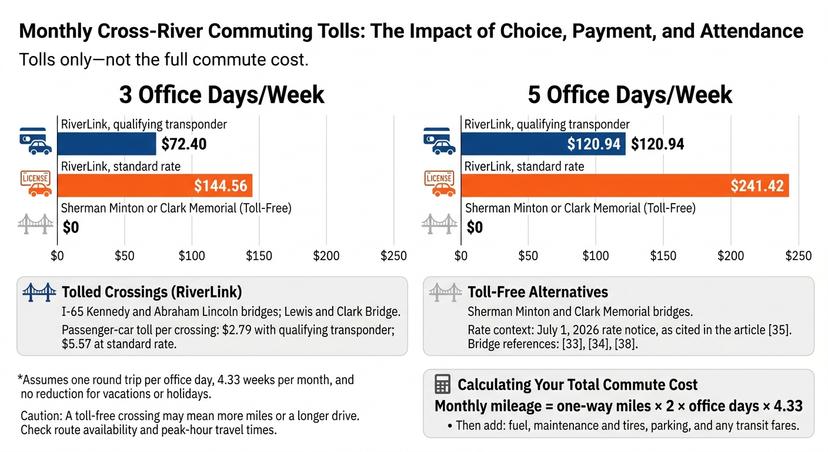
Louisville Commute Tolls: 3 vs. 5 Office Days
Electricity, Heating, Water, and Other Utilities
Compare bills for each property - not city averages. Review 12 months of bills and divide recurring charges by 12. Match homes by size, occupancy, thermostat setting, and appliance type. Insulation and HVAC costs can outweigh savings on the housing payment.
| Utility | Louisville | Southern Indiana | Matched usage and rate checks |
|---|---|---|---|
| Electricity | LG&E, where applicable | Duke Energy serves much of Clark and Floyd counties | 900 kWh/month; current tariff, fixed charge, and adjustments |
| Heating | Confirm gas provider or other heating fuel | Confirm gas provider, heat pump, electric resistance, or propane | 50 therms in a mild month for gas homes; compare annual heating costs for different systems |
| Water | Louisville Water, where applicable | Indiana American Water or municipal system | 4,000 gallons/month; meter size and minimum charges |
| Sewer | MSD, where applicable | Municipal system or sewer district | Same water usage; base, usage, and stormwater charges |
| Trash | Metro or private service | City, county, HOA, or private service | Weekly pickup; check whether included in taxes, HOA dues, or rent |
| Internet | Address-specific provider and plan | Address-specific provider and plan | Same speed tier; equipment fees and post-promotion price |
Confirm each provider using the address, lease, bill, or service map. Label each service included, partially included, or paid separately before adding up costs. Don't count services already covered by rent or HOA dues twice. Budget for deposits and connection fees separately.
Next, price the commute. Your bridge choice can change the monthly total fast.
Commuting Costs for 3 or 5 Office Days
RiverLink tolls apply to the I-65 Kennedy and Abraham Lincoln bridges and the Lewis and Clark Bridge. Sherman Minton and Clark Memorial are toll-free alternatives. A July 1, 2026 rate notice lists passenger-car tolls of $2.79 with a qualifying transponder and $5.57 at the standard rate.
| Cross-river route | Office days/week | Weekly crossings | Monthly tolls |
|---|---|---|---|
| RiverLink, qualifying transponder | 3 | 6 | $72.40 |
| RiverLink, qualifying transponder | 5 | 10 | $120.94 |
| RiverLink, standard rate | 3 | 6 | $144.56 |
| RiverLink, standard rate | 5 | 10 | $241.42 |
| Sherman Minton or Clark Memorial | 3 or 5 | 6 or 10, all toll-free | $0 |
These figures assume one round trip per office day, 4.33 weeks per month, and no reduction for vacations or holidays. They cover tolls only, not the full cost of commuting.
For each home-to-work route, record the one-way distance. Calculate monthly mileage as one-way miles × 2 × office days × 4.33. Then add fuel, a maintenance-and-tire allowance, parking, and any transit fares.
Check route availability and peak-hour travel times separately. A toll-free crossing may mean more miles or a longer drive.
Include school, child care, medical, shopping, and weekend trips, too. If the location requires a second car, add its insurance, registration, financing, and depreciation.
Conclusion: Compare Your Household Totals
Which Costs Matter Most for Your Household?
The cheapest option depends on the full monthly cost at the exact address. For property taxes, use the final bill after exemptions and caps.
| Household | Costs that will decide the result | Verify before choosing |
|---|---|---|
| Single-income Louisville commuter | Housing payment, bridge or highway travel, fuel, parking, vehicle wear, and income-tax effects | How many days a week will you commute, and does your employer pay for parking? |
| Remote worker | Housing, property taxes, insurance, utilities, internet, and workspace | Does the home have reliable broadband, adequate heating and cooling, and a suitable office? |
| Two-car household | Vehicle ownership, fuel, maintenance, replacement savings, insurance, and parking | Can you get by with one vehicle, or does each adult need a separate commute? |
| Family seeking newer or larger space | Total ownership payment, utilities, maintenance, school and child care routes, and insurance | Is the address within your preferred school boundary, and how long are daily drop-off routes? |
| Renter | Rent, renter’s insurance, utilities, deposits, parking, and commuting | Which utilities are included? Are property taxes reflected in rent rather than paid separately? |
| Buyer with a tight monthly limit | Principal and interest, taxes, insurance, HOA fees, maintenance, and emergency reserves | Is the payment still affordable after taxes, insurance, and a stress test for higher costs? |
Put those costs into the table below to compare monthly totals.
Build Your Monthly Budget
Use dated, address-specific monthly estimates in each column. Divide annual costs by 12. Note confirmed tax benefits beside the property-tax estimate; don’t subtract them again from a bill that already includes them.
| Monthly category | Louisville | Jeffersonville | Clarksville | New Albany |
|---|---|---|---|---|
| Principal and interest or rent | $ | $ | $ | $ |
| Property taxes, after confirmed benefits | $ | $ | $ | $ |
| Homeowners/renters insurance and flood coverage | $ | $ | $ | $ |
| HOA or association fees | $ | $ | $ | $ |
| Electricity, gas, water, sewer, and trash | $ | $ | $ | $ |
| Internet and household services | $ | $ | $ | $ |
| Income-tax effects | $ | $ | $ | $ |
| Sales-tax effect on typical taxable purchases | $ | $ | $ | $ |
| Fuel, tolls, transit, and vehicle maintenance | $ | $ | $ | $ |
| Parking | $ | $ | $ | $ |
| Child care and school transportation | $ | $ | $ | $ |
| Home maintenance reserve | $ | $ | $ | $ |
| Emergency reserve contribution | $ | $ | $ | $ |
| Monthly operating total | $ | $ | $ | $ |
| Upfront cash: down payment, closing costs, deposits, and moving costs | $ | $ | $ | $ |
Starting with take-home pay? Include only income taxes that haven’t already been withheld. Don’t count escrowed taxes and insurance twice, or add parking that’s included in rent or workplace benefits.
Track reserve contributions separately from operating expenses. Then test your budget against higher insurance premiums and utility bills, five office days instead of three, and one-car versus two-car ownership. Renters should also test rent increases at renewal. Buyers should check whether immediate repairs would leave enough cash for emergencies.
When totals are close, details about the individual parcel can help you decide which address fits best.
Get Local Help Verifying Property Costs
Agent Intro connects Greater Louisville and Southern Indiana buyers and sellers with one carefully selected Realtor based on local experience, availability, and working style. If you already have an agent in mind, it also offers a second-opinion introduction.
Use local help to gather property details - not to replace lender estimates, insurance quotes, official tax records, or professional tax advice. Ask for address-level details that help you check the verified monthly total against your budget and your work, school, and child care needs.
FAQs
How much cheaper must an Indiana home be to offset commuting costs?
Weigh your monthly commuting costs against the mortgage savings from a lower home price. A commute across a toll bridge can cost roughly $24 to $241 per month, depending on how often you travel, whether you use a transponder, and the frequent-user discount.
For comparison, a $10,000 drop in home price typically cuts your monthly mortgage payment by about $62.
Can I claim tax credits for working across state lines?
Tax credit eligibility depends on where you live and work. Indiana and Kentucky have a reciprocity agreement that covers wages, salaries, and commissions. If you live in Indiana and work in Kentucky, you generally won't owe Kentucky state income tax on those earnings. Local income taxes aren't covered, though.
Exceptions include maintaining a residence in Kentucky and spending more than 183 days there per year. Check with a qualified tax professional to confirm how the rules apply to you.
How would needing a second car change my housing budget?
A second car takes a bite out of your housing budget. Beyond the purchase or lease payments, you’ll need to cover auto insurance, fuel, maintenance, and possibly parking fees. If you cross the Ohio River, you’ll also need another RiverLink transponder to get frequent-user toll discounts.
Budget for both cars alongside your housing costs: mortgage payments, property taxes, home insurance, utilities, and maintenance reserves. That gives you a clearer picture of how much housing you can afford.
Ready for a thoughtful introduction?
Tell us about your move. Get one carefully selected introduction. No obligation to hire.
Find my agent ↗