
7 Louisville New Build Fees Buyers Often Miss
Don’t assume a new-build base price covers everything—7 Louisville fees can add lot premiums, lender charges, inspections, utilities and HOA costs.
- Agent Selection
- Local Market
- Real Estate
A Louisville new-build base price isn’t your total cost. I’d check these 7 charges before signing - and ask for a written breakdown of what’s due before closing, at closing, and after move-in:
- Lot premiums: Extra charges for the homesite you choose.
- Builder transfer and administrative fees: Builder charges separate from taxes.
- Rate-lock and extension fees: Mortgage costs that can grow if construction runs late.
- Independent inspections: Out-of-pocket costs for checks during construction, before closing, or before the warranty ends.
- Utility deposits and connection fees: Charges to start service, with refund terms that vary.
- HOA setup fees, contributions, and dues: Upfront charges plus regular payments.
- Prepaid taxes, insurance, interest, and escrow deposits: Closing expenses that depend on your home, loan, and closing date.
My rule: <u>count each charge once, and count credits only after written approval</u>. Compare the purchase agreement, Loan Estimate, HOA documents, and utility terms - not just advertised prices. Then separate cash needed to buy the home from monthly ownership costs.
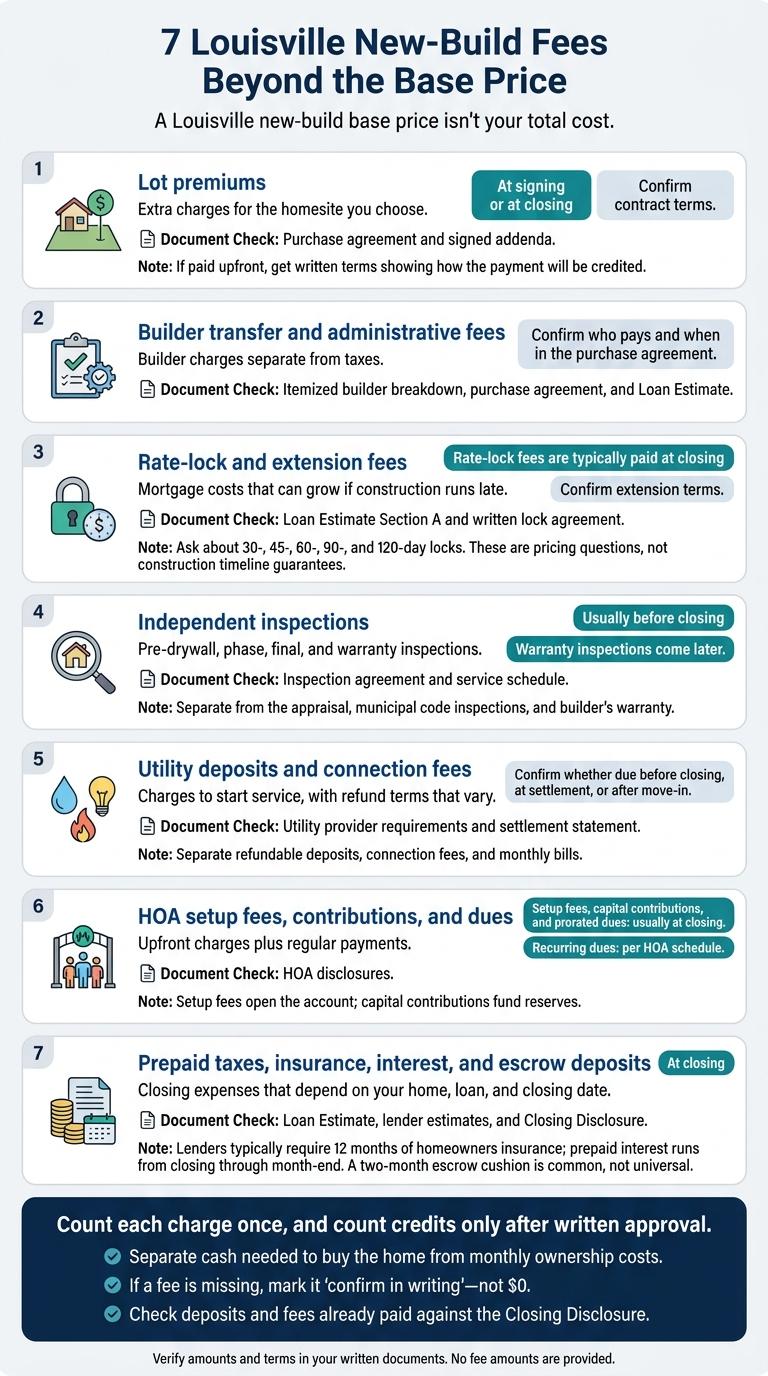
7 Louisville New-Build Fees Beyond the Base Price
Building Your Dream Home Costs More Than You Think! | Louisville, KY Real Estate
Documents to Check Before Comparing New-Build Prices
Request the purchase agreement and addenda, itemized price sheet, written credit terms, Loan Estimate, HOA documents, and utility requirements. Check that each document matches the builder, homesite, and financing offer.
Use the price sheet to fill in the table below with contract price components only. This helps separate costs buyers often overlook before closing.
| Price component | First builder and homesite | Second builder and homesite |
|---|---|---|
| Base price | Enter quoted amount | Enter quoted amount |
| Lot premium | Enter homesite charge | Enter homesite charge |
| Selected upgrades | Enter itemized total | Enter itemized total |
| Incentive credit | Enter only the written credit amount | Enter only the written credit amount |
| Contract price | Enter contract total | Enter contract total |
After verifying the base price, check the line items where extra costs may be tucked away.
Read the written credit terms before counting any credit. On the Loan Estimate, review Section A for origination charges, Section B for services you cannot shop for, and Section C for services you can shop for. Check title services as well, if they appear on the Loan Estimate.
Review the HOA documents and utility requirements for charges missing from the price sheet. Record the property’s jurisdiction on your comparison sheet - costs don't carry over across counties or states. Keep location-specific charges and financing estimates tied to the property you're comparing.
With the documents matched, check each fee against the contract itself.
1. Lot Premiums
What Triggers the Charge
A lot premium is an extra charge for a homesite. It often appears in the contract rather than the advertised price. If you’re choosing a cul-de-sac, wooded, view, or walkout basement lot, ask the builder exactly what the premium covers.
When You Pay
Confirm whether you’ll pay the premium at signing or as part of the purchase price at closing. If you pay upfront, get written terms showing how that payment will be credited so you don’t pay it twice.
Refundability and Financing
Ask your lender whether you can finance the premium. Then check the contract to see what happens to the charge if your loan is denied or the appraisal comes in low.
Negotiation and Incentives
Ask the builder to reduce or waive the premium. Any agreement belongs in the purchase agreement or a signed addendum - not just a sales conversation. Before signing, get the refundability, financing, and incentive terms in writing.
Next, check whether the builder adds separate transfer or administrative fees on top of the homesite charge.
2. Builder Transfer and Administrative Fees
Builders may charge contract-level fees on top of the homesite price.
What Triggers the Charge
A builder transfer or administrative fee is a builder-set contract charge, not a tax. Request an itemized breakdown of what it covers. Ask whether document preparation and management are included in the price or billed separately.
When You Pay
Review the purchase agreement to confirm who pays the fee and when it’s due. Compare those terms with the Loan Estimate’s Taxes & Government Fees section. If the lender hasn’t received the purchase agreement, it may list the transfer fee on the buyer’s side until it verifies who pays.
Refundability and Financing
Ask which fees require cash payment and which your loan program lets you finance.
Negotiation and Incentive Coverage
Ask for a waiver or a builder credit toward eligible closing costs. The contract terms and lender rules determine what the credit can cover. It cannot exceed your closing costs or go toward your down payment.
Next, compare lender rate-lock and extension fees.
3. Rate-Lock and Extension Fees
What Triggers the Charge
A rate lock holds your mortgage rate for a set period. Longer locks usually cost more, and new-build delays can cause lock and extension fees to add up fast.
Ask for pricing on 30-, 45-, 60-, 90-, and 120-day locks, along with the lender’s relock and extension rules. Extension fees vary by lender: some charge a flat fee, while others charge by the day.
When You Pay
Rate-lock fees usually appear in Section A of the Loan Estimate and are typically paid at closing. Once your rate is locked, the lender is generally bound to the quoted fee unless the loan or purchase terms change.
Refundability and Financing
Ask whether your loan program lets you roll this fee into the loan.
Next, check inspection fees. You’ll pay those separately, usually before closing.
4. Independent Inspection Fees
What Triggers the Charge
Set aside a separate budget for pre-drywall, phase, final, and warranty inspections. Buyers often pay inspection fees out of pocket before closing, while warranty inspections come later.
These fees are separate from the appraisal, municipal code inspections, and the builder’s warranty.
Financing and Incentive Coverage
Planning to use a builder or lender credit? Ask your lender which inspection fees qualify as closing costs. Credits can’t exceed total closing costs or cover your down payment.
Next, check utility deposits and connection fees. Those bills can also arrive before move-in.
5. Utility Deposits and Connection Fees
After inspection fees, check what it costs to connect the home’s utilities and get it ready for move-in. Some charges aren’t included in the base price and must be paid separately from closing.
What Triggers the Charge
Ask which charges apply to electric, gas, water, sewer, internet, and similar services at the property. Separate connection fees from refundable deposits and monthly bills so you know what you’re paying for.
When You Pay
Confirm whether each charge is due before closing, at settlement, or after move-in. Utility deposits are usually due when you start service. Check the settlement statement for adjustments and credits covering utility charges split between you and the builder.
Refunds and Financing
Set aside cash for utility deposits. They’re often refundable, but ask the provider about the refund conditions and timing. Don’t assume a connection fee is refundable. Confirm how the provider and lender treat it.
Negotiating Fees and Using Incentives
Get written confirmation of any utility work the builder will cover. Ask whether a credit can reduce your cash to close, then check it against the settlement statement so you don’t pay twice.
Next, check whether the neighborhood charges HOA setup fees or dues.
6. HOA Setup Fees, Contributions, and Dues
What Triggers the Charge
HOA charges usually start when the builder transfers the home and opens your owner account. Setup fees cover opening the account, while capital contributions fund reserves. Both are separate from regular dues.
When You Pay
In Louisville new-build communities, setup fees, capital contributions, and prorated dues are usually due at closing. Prorated dues cover your share of the current billing period. After that, regular dues follow the HOA’s monthly or annual schedule.
Next, check prepaid taxes, insurance, interest, and escrow deposits.
7. Prepaid Taxes, Insurance, Interest, and Escrow Deposits
After builder and HOA charges, add lender-required prepaid costs to your cash-to-close total.
What Triggers the Charge
Lenders typically require 12 months of homeowners insurance, interest from closing through month-end, and escrow deposits for future tax and insurance bills. Your escrow deposit depends on your insurance premium, tax due dates, and lender rules. A two-month cushion is common.
When You Pay
These charges are due at closing. The earlier you close in the month, the more prepaid interest you owe. Ask your lender for written estimates based on your closing date and loan type.
Don’t use the vacant-lot tax estimate. Ask Jefferson County PVA for the completed-home assessment, then confirm the lender’s tax and escrow estimates. A higher finished-home assessment can increase both your monthly payment and your escrow deposit.
Refundability and Financing
Prepaid interest pays for borrowing days already used, so it isn’t refundable. The escrow cushion may be refunded when you pay off the loan or refinance. You’ll generally pay these costs in cash at closing unless a credit covers them.
Negotiability and Incentive Coverage
Ask which prepaid items a credit can cover. Include only the approved credit amount in your cash-to-close estimate.
Use these figures in the comparison sheet below.
Create a Fee Comparison Sheet
Use one sheet per home, with the same rows for every builder. Take amounts only from the purchase agreement, options sheet, Loan Estimate, HOA disclosures, and Closing Disclosure. If a fee is missing, mark it “confirm in writing” - not $0.
Use this checklist to compare the seven fee categories and their related charges.
| Fee name | Quoted amount (USD) | Payee | Payment date | Refundability | Financing eligibility | Negotiability | Builder credit? |
|---|---|---|---|---|---|---|---|
| Lot premium | Check contract | Builder | At closing | No | Yes | High | Check lender rules |
| Builder transfer/admin fee | Check contract | Builder | At closing | No | No | Low | Check lender rules |
| Rate-lock and extension fees | Check Loan Estimate | Lender | Check lock agreement | Usually no | No | Low | Check lender rules |
| Independent inspection | Check inspection agreement | Inspector | At time of service | No | No | Yes | Check lender rules |
| Utility deposits and connection fees | Check provider requirements | Utility provider | Check provider terms | Depends on charge | Check lender rules | Check builder contract | Check lender rules |
| HOA setup fee | Check HOA disclosures | HOA | At closing | No | No | None | Check lender rules |
| HOA capital contribution | Check HOA disclosures | HOA | At closing | No | No | None | Check lender rules |
| Prorated HOA dues | Check HOA disclosures | HOA | At closing | No | No | None | No |
| Recurring HOA dues | Check HOA disclosures | HOA | Per HOA schedule | N/A | No | None | No |
| Prepaid interest | Check Loan Estimate | Lender | At closing | No | Check lender rules | None | Yes |
| 12-month homeowners insurance premium | Check Loan Estimate | Insurer | At closing | No | No | Yes (shop around) | Yes |
| Escrow reserves for taxes and insurance | Lender estimate | Lender | At closing | Refundable balance under loan terms | No | None | Yes |
Group costs by when you pay them: before closing, on closing day, or on a recurring schedule. Check deposits and fees you’ve already paid against the Closing Disclosure so each charge appears only once.
Record the dates covered by prorated HOA dues, then start recurring dues after that period ends. Add prorated property taxes under Adjustments and Other Credits. Apply only lender-approved credits to eligible charges.
Check financing eligibility separately. A fee included in the purchase price isn’t guaranteed to be fully financed. Use the completed sheet to compare true cash to close, not just the base price.
Conclusion: Budget Beyond the Base Price
Once your fee sheet is complete, ask for written fee disclosures and updated cash-to-close estimates as construction moves forward.
Compare your Loan Estimate with the final Closing Disclosure. Check that prepaids, deposits, and credits line up, and resolve any differences.
Count each fee only once. Don’t double-count financed lot premiums or add charges already included in the loan. Keep recurring utilities and HOA dues out of your cash-to-close total.
Judge whether the home fits your budget using the total - not just the base price.
Total cash to plan for = down payment + closing costs and prepaid items + builder charges + inspection expenses + utility deposits + contingency reserve − deposits and credits already applied.
FAQs
Who pays rate-lock extension fees if my builder causes delays?
Your purchase agreement spells out who pays rate-lock extension fees when your builder causes a delay. There’s no universal rule that requires builders to cover these fees.
Before you sign, have your real estate agent review the builder’s contract. Check whether the closing date is firm or estimated, and make sure the contract clearly names who pays delay-related costs.
What happens if my home appraises below the price with upgrades?
If your home appraises for less than the purchase price - including upgrades - your lender will generally base the loan on that lower value. You’ll need to address the gap. You can usually negotiate a lower price with the builder, cover the difference in cash, or cancel if your contract includes an appraisal contingency.
Builders often use their own purchase agreements, so read your contract closely to see how it handles appraisal shortfalls.
How can I budget for taxes before my new home is assessed?
Check the estimated property tax rate for your address with your county tax authority or real estate agent. New-construction assessments can lag, so lenders may base escrow estimates on the land’s value or projected improvements.
Set aside savings to cover tax adjustments once the property is fully assessed. Apply for any property tax exemptions you qualify for immediately after closing to help manage your long-term monthly costs.
Ready for a thoughtful introduction?
Tell us about your move. Get one carefully selected introduction. No obligation to hire.
Find my agent ↗