
7 Questions to Ask a Realtor Before Hiring Them
Don't hire the first agent - ask seven specific questions to reveal who truly fits your location, timeline, and budget.
- Agent Selection
- Local Market
- Real Estate

I recommend interviewing two or three Realtors before signing an agreement. Ask each the same seven questions, then compare their answers against your budget, location, and timeline - not just their fee or suggested sale price.
- Experience: What recent purchases or sales have you handled that match my needs?
- Local knowledge: Which Louisville or Southern Indiana neighborhoods do you know best?
- Plan: How will you handle my purchase or sale, including delays or problems?
- Communication: How will we stay in touch, and who covers when you’re unavailable?
- Responsibilities: Who handles showings, negotiations, paperwork, and deadlines?
- Costs and terms: What will I pay, what services are included, and how can I end the agreement?
- References: Can I speak with recent clients whose transactions were like mine?
I’d ask for recent examples, client references, and <u>written fees and contract terms</u>. Commissions are negotiable. If your search crosses the Ohio River, confirm who is licensed to represent you in each state. Before signing, make sure the agreement matches what you discussed.
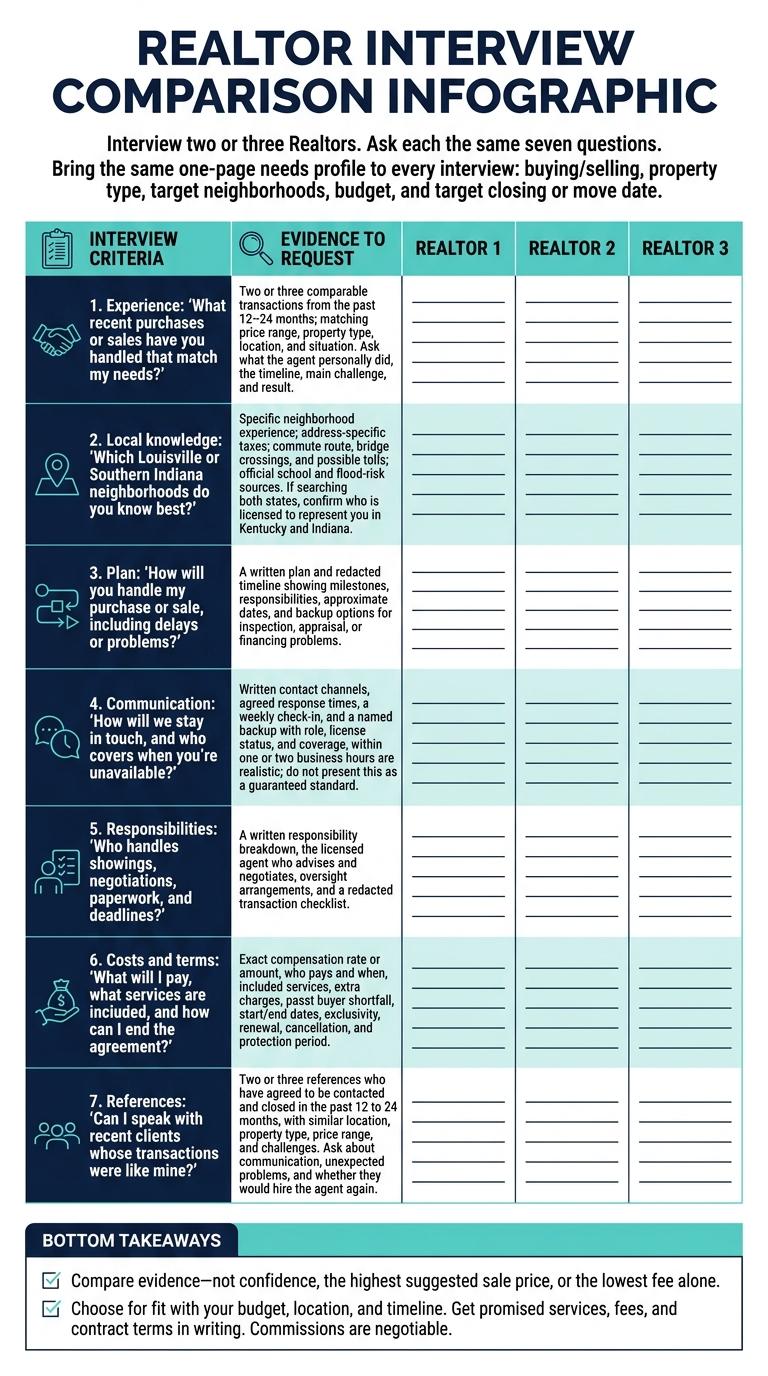
7 Questions to Compare Realtors Before Hiring
Before the Interview: List Your Needs
Put together a one-page profile to keep each Realtor interview focused. Include whether you’re buying, selling, or both, along with your property type, target neighborhoods, budget or expected sale price, and target closing or move date. Separate must-haves from preferences so agents can see where you’re flexible.
Get specific about location. Conditions differ across Louisville Metro, Jeffersonville, New Albany, Clark County, Floyd County, and Sellersburg. Note your preferred communities, commute route, school priorities, and whether you’ll search on both sides of the Ohio River. If so, ask about recent experience in each area - not just general familiarity with Kentuckiana.
Buyers: Include your preapproval status, loan type, down-payment range, purchase-price ceiling, and comfortable monthly payment. Note whether you need to sell another home before buying.
Sellers: Gather your mortgage payoff estimate, desired net proceeds, major upgrades, known defects, and the ages of your roof and HVAC system. Your expected sale price is a starting point for discussion, not an established market value. Leave account numbers and full financial documents out of the first interview.
Spell out your service needs: availability for showings, acceptable showing windows, preferred contact method, and how often you want updates. Include any staging, repair, or inspection support you expect, plus deadlines tied to a lease, relocation, or rate lock. These details help you judge whether the agent’s schedule and services fit your move.
Bring the same profile to every interview so each Realtor works from the same facts.
1. What recent experience do you have with buyers or sellers like me?
This question separates general experience from work that matches your transaction.
Specific examples to request
Ask for two or three comparable transactions from the past 12–24 months that match your price range, property type, location, and situation.
Relevant situations include a first-time purchase, relocation, investment, or sale tied to another purchase.
For each example, ask about the approximate price, timeline, main challenge, actions taken, and result. Focus on what the agent personally did - not just what their team sold.
What the answer tells you
Find out whether the Realtor handled the work personally or contributed as part of a team. Did they represent the buyer or seller? Did they handle pricing, offers, inspection negotiations, lender or title coordination, or problems that came up before closing?
Team sales totals don't prove that an individual agent has handled work like yours. Recent, relevant work matters more than years licensed alone. These details help you judge whether their experience fits your needs.
Signs of a good fit
Strong answers explain decisions and trade-offs. First-time buyers need someone who can explain financing and contingencies. Move-up buyers need an agent who knows how to coordinate a sale and purchase. Sellers should hear how the agent handled pricing, showing feedback, and inspection issues.
Look for answers that connect past work to your needs and acknowledge risks. General answers are a warning sign.
Warning signs
Be cautious about vague career claims, unsupported awards, or team results presented as personal work. Watch for agents who give every client the same advice, avoid discussing difficult deals, or guarantee a price or timeline.
Ask how you can verify their transactions through records or recent client references. If the agent can't provide relevant examples, move on.
2. Which Louisville or Southern Indiana neighborhoods do you know best?
Once you know the agent has handled work like yours, check how well they know the areas where you want to buy or sell. Compare each Realtor’s neighborhood knowledge against your budget, commute, and property type.
Specific examples to request
Ask for neighborhood names - not just Louisville Metro - and comparisons of housing age and condition, commute times, taxes, city services, and flood exposure.
Examples include Germantown, St. Matthews, the East End, New Albany, Jeffersonville, or Sellersburg.
Have the agent use your actual workplace and route when discussing commute times. That includes bridge crossings and possible tolls, rather than a generic estimate for getting downtown.
What the answer tells you
Look for address-specific tax estimates, not metro-wide averages. Ask which tax district applies to each property, then verify the details with the county office. Specific answers show whether the agent can explain local costs and trade-offs.
Signs of a good fit
A strong agent relies on official sources and encourages you to check the details. Confirm school assignments with the district, and check flood risk through FEMA and local drainage sources.
If you’re searching in both states, confirm that the agent is licensed in Kentucky and Indiana. Ask who will handle each side of the deal.
Warning signs
Reject fixed commute claims, blanket tax estimates, unsupported school claims, and promises that a property cannot flood. Recommendations should reflect your budget, commute, property needs, and service expectations - not protected characteristics.
Ask how the agent will put that local knowledge to work in a clear plan for your search or sale.
3. What is your plan for my home purchase or sale?
Once you know the agent understands your market, ask how they’ll handle your purchase or sale from start to finish.
Specific examples to request
Ask for a written plan built around your budget, timeline, and property. Request a redacted timeline that shows milestones, who handles each task, and approximate dates.
| Buyer strategy | Seller strategy | Evidence provided | Concern to watch for |
|---|---|---|---|
| Search criteria, alerts, showings, and offer strategy | Pricing, preparation, repairs, photography, marketing, and showings | Dated comparable sales, inventory, days on market, and sale-to-list data | Unsupported pressure to overprice or underbid |
| Inspection negotiations, appraisal, lender communication, and title work | Offer comparison, negotiation, inspection response, and appraisal planning | Written offer summary and contingency deadlines | Ignoring protections or focusing only on price |
| Contingency follow-up, final walkthrough, and closing coordination | Closing coordination and a backup plan if buyer financing falls through | Timeline showing responsibilities and decision points | Vague deadlines or no backup plan |
What the answer tells you
The plan should explain how the agent will put local knowledge to work. Ask which property segment and date range support their approach. When discussing results, have the agent separate list price, contract price, and final net proceeds. A broad average alone doesn’t justify your offer or asking price.
Signs of a good fit
Look for clear options if inspections reveal defects, the appraisal comes in low, or financing is delayed.
For sellers, the agent should set a pricing-review date and explain how showing activity, buyer feedback, and competing listings will guide any changes. For buyers, the plan should cover lender documents, inspections, homeowners insurance, title insurance, revised Loan Estimates, and final document review.
Warning signs
Be wary of guaranteed sale prices, promises that your offer will win, or pressure to skip professional inspections. The agent should explain the risks and leave decisions with you, not push unsupported pricing, unnecessary repairs, or offers beyond your comfortable budget.
4. How will we communicate, and who covers when you are unavailable?
Specific examples to request
After local knowledge, check how the agent will keep you informed when the deal moves fast. Agree on which channels to use for urgent issues, routine updates, and documents. Set response times, evening and weekend availability, and a weekly check-in - then confirm the plan in writing. Ask whether replies within one or two business hours are realistic.
What the answer tells you
The answer should explain who contacts you during inspections, appraisal, title work, and closing, plus how urgent problems will reach you. Every update should spell out what is pending, the next deadline, and who owns the next step. Delays happen, but you shouldn’t have to guess what comes next.
Signs of a good fit
Ask for the backup contact’s name, role, phone number, license status, and authority to handle showings or negotiations. You want a planned handoff that keeps your primary agent informed - not a vague promise that someone at the office will help. Confirm whether coverage extends to both states, especially if you’re searching in Louisville and Southern Indiana.
Warning signs
A promise to be “always available” matters less than reliable coverage. Be cautious if the agent won’t commit to response times, discourages written records, or can’t explain how to get help with urgent issues after hours. Treat follow-up as a test. Several days of unexplained silence or missing requested information is a reason to reconsider.
5. Who will handle each part of my transaction?
Specific examples to request
Once you’ve confirmed how communication will work, ask who handles each step. Request a written breakdown of responsibilities that names who manages showings, listing preparation and photography, offer drafting, negotiations, inspection responses, documents, and closing coordination.
Ask which appointments the primary Realtor will attend, especially the initial consultation, inspection, final walkthrough, and closing. If they’re unavailable, who takes their place at each key meeting?
What the answer tells you
The answer identifies who’s accountable for advice, deadlines, and confidential information. A transaction coordinator handles documents and deadlines, but you should clarify which licensed agent explains contingencies, recommends terms, and negotiates repairs or credits.
You need to know who supports the deal, who represents you, and who takes responsibility if something goes wrong. In Kentucky, ask which licensed agent represents you and how they handle your private information.
Signs of a good fit
Look for clear oversight. Who reviews offers and amendments before they go out? Who tracks contingency deadlines? Which broker or team leader steps in when a problem is beyond the team’s authority or ability to resolve?
Request a redacted transaction checklist to see how those responsibilities work in practice.
Warning signs
Be cautious if nobody can identify your representative or explain who may negotiate on your behalf. An assistant’s job title alone doesn’t establish their authority.
Unexplained handoffs, unclear licensing, or uncertainty about who reviews price, contingencies, and deadlines leave too much room for mistakes. Next, review fees and contract terms.
6. What are your fees, services, and contract terms?
Once you know who will handle the work, confirm what you’ll pay and what you’re agreeing to.
Specific examples to request
Ask for the actual Kentucky or Indiana brokerage agreement, plus an itemized breakdown of fees and services. Get the exact percentage, flat fee, hourly rate, or other amount you can calculate. Confirm who pays and when payment is due.
The breakdown should spell out what’s included: marketing, showings, negotiation, inspection support, and closing coordination. It should also list extra charges for photography, staging, administration, or transaction fees. Commissions are negotiable - not fixed by law.
Check the exact start and end dates, exclusivity, automatic renewal, cancellation notice and fees, and any protection period that could leave you owing compensation after termination. Ask which disclosures and consents apply. In Kentucky, ask about the Agency Consent Agreement, which is required before entering a written brokerage-services agreement or completing or directing certain transaction documents.
For many MLS participants, a written buyer agreement is required before an in-person or live virtual tour. Open houses usually don’t trigger that requirement.
What the answer tells you
These details show your total cost and financial risk, not just the advertised fee. Buyers should ask how contributions from the seller or listing broker will be requested, documented, and credited - and who pays any shortfall. Buyer-agent compensation cannot exceed the amount in the buyer agreement.
Don’t accept open-ended wording such as:
whatever the seller offers
Signs of a good fit
A good agent shares the agreement before asking you to sign, explains every charge, and puts changes in writing. If cancellation terms or obligations that continue after the agreement ends are unclear, wait to sign until you have answers.
| Comparison point | Record for each agent |
|---|---|
| Compensation | Exact rate or amount, who pays, payment timing, possible buyer shortfall |
| Included services | Specific deliverables - not simply full service |
| Contract term | Start/end dates, exclusivity, renewal, protection period |
| Cancellation | Notice, fees, release process, protection period |
| Extra costs | Itemized administrative, marketing, staging, and other charges |
| Unanswered questions | Items needing written clarification before signing |
Warning signs
Watch for pressure to sign immediately, hidden fees, incomplete documents, unexplained renewal clauses, or unclear responsibility for buyer shortfalls. A professional should welcome comparison shopping and explain every negotiable term. If a fee or term remains unclear, use the next question to check the agent’s service with recent clients.
7. Can I speak with recent clients whose transactions were like mine?
Recent clients can help you check the agent’s claims about their experience, local knowledge, communication, and process.
Specific examples to request
Ask for two or three references who have agreed to be contacted. Look for clients who closed in the past 12 to 24 months and match your location, property type, price range, and main challenge.
What the answer tells you
Sellers: Ask about the list price, sale price, and days on market. Buyers: Ask whether the agent’s offer advice lined up with recent comparable sales and current market conditions.
Then ask how the agent handled one issue - price, repairs, contingencies, appraisal, inspection, or closing date - and one unexpected problem.
Signs of a good fit
Look for specific, balanced accounts that show whether the agent’s promises match the client’s experience. Did the agent provide updates without being asked? Did the person you interviewed actually handle the deal?
Ask whether the client would hire the agent again and what they would do differently. A difficult transaction handled well can tell you more than an easy closing.
Warning signs
Vague compliments, old or unrelated references, and conflicting accounts deserve follow-up - not automatic rejection. Protecting client privacy is appropriate, but an agent who refuses every form of verification should be willing to explain why.
If direct calls aren’t available, ask for testimonials shared with client permission or transaction details with identifying information removed.
Conclusion: Compare Answers Before You Sign
After the interviews, compare answers to the seven questions side by side. Look at each Realtor’s experience, local knowledge, strategy, communication, staffing, costs, terms, and references. Record the evidence behind each answer, not just how confident the Realtor sounds.
Choose the Realtor whose local experience, strategy, and terms fit your location, timeline, and budget. Don’t base your choice on the highest price or lowest fee alone. Look at the reasoning behind those numbers and which services are included.
Get answers to any remaining questions before reviewing the agreement. Confirm who represents you, who handles day-to-day work, how soon you can expect responses, and who provides backup coverage. Ask for promised services in writing, then check that the agreement reflects what you discussed.
Review compensation, extra charges, agreement length, exclusivity, renewal, and cancellation terms. Buyers should confirm whether the Realtor will request seller-paid compensation and how any shortfall would be handled. Compensation is negotiable, and the written buyer agreement should clearly state the services and compensation.
In Kentucky, the agency guide explains representation but does not replace the brokerage contract. If a clause is unclear, get independent legal advice before signing. The Kentucky Real Estate Commission cannot interpret private contracts for consumers. Keep a copy of every signed document.
FAQs
How can I verify a Realtor’s license and disciplinary history?
Search the agent’s name or license number on the Indiana Professional Licensing Agency’s eVerification website to check their license status and disciplinary history. For Kentucky, use the Kentucky real estate license lookup tool separately. Confirm that the license is active and verify which brokerage the agent works with.
Asking for a license number is standard practice. If an agent hesitates to share it, that’s a red flag.
What if I’m unhappy after signing a Realtor agreement?
Before signing a listing or buyer agency agreement, ask how you can end the relationship if you’re unhappy. These agreements are legal contracts, so check how long they last and what the early termination terms require.
Already signed? Review the agreement with your current brokerage or consult a qualified real estate attorney to understand your rights and any obligations you may have.
Can the same brokerage represent both buyer and seller?
Yes. A licensee can represent both the buyer and seller through dual or limited agency. In Indiana, all parties must consent in writing. The disclosure must also state that consent is not required.
When one agent represents both sides, no information is considered confidential, and the agent no longer acts solely to protect your individual interests.
Ready for a thoughtful introduction?
Tell us about your move. Get one carefully selected introduction. No obligation to hire.
Find my agent ↗