
Buyer's Agent vs. Listing Agent: What's the Difference
Who represents you matters — buyer’s agents work for buyers and listing agents for sellers; confirm representation, fees, and licensing in writing.
- Agent Selection
- Local Market
- Real Estate

A buyer’s agent works for you when you buy. A listing agent works for you when you sell. My advice: confirm who represents you, what services you’ll get, and what you may owe before signing an agreement.
<u>Talking to the listing agent does not make them your agent.</u> Fees are negotiated, and sellers don’t have to cover the buyer’s agent’s fee.
Quick Comparison
| What to compare | Buyer’s agent | Listing agent |
|---|---|---|
| Represents | Buyer | Seller |
| Main tasks | Home search, tours, offers, and inspection requests | Pricing, marketing, showings, and offer review |
| Negotiation focus | Purchase price, repairs, and contingencies | Sale proceeds, terms, and closing date |
| Agreement | Buyer-representation agreement | Listing agreement |
| Payment | Buyer may owe any fee not covered by the seller | Seller owes the agreed listing fee |
For a Louisville–Southern Indiana move, I’d check local experience, communication, and licensing in both states if the agent will work on both sides of the river. Buying and selling calls for separate agreements; that’s different from one agent representing both parties in the same sale.
Agent Intro offers one local Realtor introduction based on your needs, plus a second-opinion introduction if you want to assess your current agent’s fit. Review any existing contract before changing agents.
Buyer’s Agent vs. Listing Agent: Roles and Duties
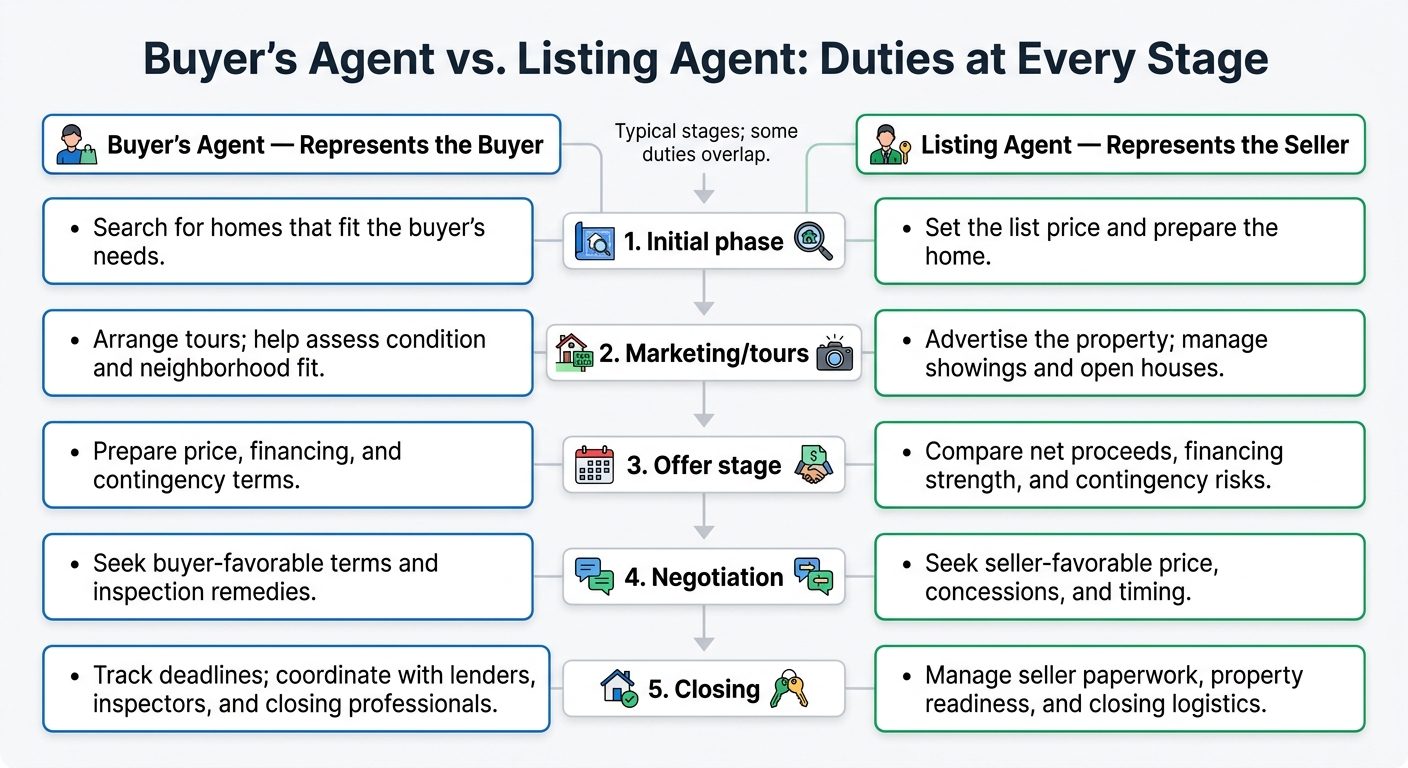
Buyer’s Agent vs. Listing Agent: Duties at Every Stage
Once representation is set, each agent has a different focus: the buyer’s agent handles the search and purchase negotiations, while the listing agent handles pricing and marketing for the seller.
Buyer’s Agent: Finding Homes and Negotiating Purchases
A buyer’s agent builds a home search around your budget and priorities, arranges tours, and negotiates contingencies and inspection requests. Across Louisville and Southern Indiana, they compare asking prices with recent nearby sales and monthly housing costs. They also prepare your offer, explain contingencies, and track deadlines with your lender and closing professionals.
Hypothetical Jeffersonville purchase: $325,000. Your agent checks nearby sales before recommending offer terms and includes an inspection contingency. If the inspection identifies an aging roof, the agent uses estimated replacement costs to support a request for a $5,000–$10,000 credit. That is a negotiation request - not a guaranteed concession or a roof replacement estimate.
Listing Agent: Pricing, Marketing, and Reviewing Offers
A listing agent sets the price, markets the home, manages showings, and reviews offers. They recommend home preparation and professional photography, handle seller disclosures, and promote the property through the MLS and other channels.
Price isn’t the only factor when comparing offers. The agent also weighs net proceeds, financing, contingencies, and timing. After the seller accepts an offer, the agent handles seller-side negotiations and closing logistics.
Hypothetical Highlands sale: A higher-priced offer carries extensive contingencies; a lower-priced offer has stronger financing and a faster closing. The listing agent explains whether the higher price could face appraisal problems, how contingencies could delay the sale, and which closing date fits the seller’s plans. The lower offer may be less risky, but neither financing strength nor speed guarantees closing.
Transaction Duties Compared
Here’s how the agents’ duties differ at each stage.
| Stage | Buyer’s Agent Responsibilities | Listing Agent Responsibilities |
|---|---|---|
| Initial phase | Search for homes that fit the buyer’s needs. | Set the list price and prepare the home. |
| Marketing/tours | Arrange tours; help assess condition and neighborhood fit. | Advertise the property; manage showings and open houses. |
| Offer stage | Prepare price, financing, and contingency terms. | Compare net proceeds, financing strength, and contingency risks. |
| Negotiation | Seek buyer-favorable terms and inspection remedies. | Seek seller-favorable price, concessions, and timing. |
| Closing | Track deadlines; coordinate with lenders, inspectors, and closing professionals. | Manage seller paperwork, property readiness, and closing logistics. |
Agent Agreements and Compensation
Representation and payment are separate. A buyer-representation agreement sets the terms of the buyer-broker relationship. A listing agreement authorizes the broker to market and sell the home. Compensation is negotiated and can differ by agreement, brokerage, and property.
Agreement Terms to Confirm in Writing
These contracts spell out who the agent represents and what the client owes. Confirm the services, start and end dates, exclusivity, cancellation terms, and coverage area in writing.
For a Louisville–Southern Indiana search, make sure the agreement names the counties you want covered.
Check the holdover clause, too. It may require payment if you close later on a property or with a contact the broker introduced.
Current REALTOR® rules require a written buyer agreement before touring homes. The agreement must state the relationship and compensation amount in dollars or as a percentage. Before signing, check how the fee is calculated and whether you’ll owe a balance if the seller contributes less than your agreed fee.
Sellers don’t have to pay the buyer’s agent. Any seller contribution should be documented separately from repair or closing-cost concessions. Buyer-agent compensation can no longer be advertised on the MLS.
Who Signs, Who Pays, and Who Is Represented
| Term | Buyer-Representation Agreement | Seller’s Listing Agreement |
|---|---|---|
| Who signs | Buyer and buyer’s broker. | Seller and listing broker. |
| Negotiated fees | A stated dollar amount or percentage. | An agreed commission or flat fee. |
| Who pays | Buyer may owe the fee, depending on the contract and any seller contribution. | Seller pays the agreed listing fee from sale proceeds. |
| Written terms | Confirm services, scope, duration, exclusivity, and cancellation before touring homes. | Confirm marketing services, duration, compensation, and cancellation before listing. |
| If the transaction does not close | Check payment triggers and any holdover clause. | Check withdrawal and default terms. |
Read the payment and termination clauses before signing, particularly any terms that leave the buyer responsible for a gap between the agreed fee and the seller’s contribution.
With those terms clear, you can focus on choosing an agent who fits your side of the deal.
Which Agent Do You Need in Kentuckiana?
Once you understand representation and compensation, choose an agent for your side of the deal.
Buying? Choose buyer-side representation before you tour homes.
Selling? Hire a listing agent before you start preparing the home. Getting advice early helps you decide which improvements, staging, photography, and pricing steps belong in your plan - before you spend money.
If you’re buying and selling, use separate agreements for each side so one agent can coordinate both closings. That’s different from dual agency, where one agent represents both the buyer and seller in the same transaction.
Check Local Experience and Working Style
In Kentuckiana, local knowledge matters most when your move takes you across the river.
Ask about the agent’s recent work in your target neighborhood, with your property type, and on deals with timing constraints like yours. Talk about availability, communication, and how they handle negotiations. For a Louisville-to-Southern Indiana move, verify that the agent is licensed in both Kentucky and Indiana and knows local taxes and closing procedures.
How Agent Intro Matches You With a Local Realtor
Agent Intro helps narrow your search by matching you with an agent for the side of the transaction you need.
Using a brief match profile and human review, Agent Intro introduces you to one local Realtor based on skills, local experience, availability, and working-style fit. You get one introduction, not a list of leads. Say whether you’re buying, selling, or doing both so the match reflects the help you need.
Agent Intro also offers a second-opinion introduction to help you assess an agent’s fit. If you’ve already signed an agreement, review your existing obligations before changing representation.
Conclusion: Choose an Agent for Your Side of the Sale
A buyer’s agent works for the buyer - finding homes, writing offers, and negotiating repairs. A listing agent works for the seller - pricing the home, marketing it, and reviewing offers.
Before moving forward, confirm representation and compensation in writing. If you’re buying, ask what you’ll owe if the seller’s contribution doesn’t cover your agreed buyer-agent fee.
Once those terms are clear, share your preferred Louisville or Southern Indiana neighborhoods, property type, budget or target sale price, and timeline with Agent Intro. You’ll get one local Realtor match suited to your plans.
FAQs
What should I avoid sharing with the listing agent?
Keep your maximum budget - and anything else that could weaken your negotiating position - to yourself. The listing agent represents the seller, not you, and works to protect the seller’s interests.
In multiple representation, one agent represents both parties, and no information is considered confidential. Rely on your own buyer’s agent to speak up for you, protect your interests, and keep your financial details and negotiation plans private.
Can I negotiate my agent’s fee after signing?
Once you sign a buyer representation agreement, you’re generally bound by its terms - including your agent’s fee. All terms, including compensation, are negotiable before you sign.
Discuss any discounts or fee adjustments and confirm how the commission will work before signing. Read the agreement carefully so you understand your relationship with your agent and what you’ll be expected to pay.
How can I verify an agent’s Kentucky and Indiana licenses?
Ask for the agent’s active license details, including their name and brokerage. Then verify that information through official Kentucky and Indiana licensing records.
Before showings, make sure the agreement you sign clearly spells out your working relationship and agreed compensation in writing. This helps you confirm you’re working with a properly licensed agent or broker from the start.
Ready for a thoughtful introduction?
Tell us about your move. Get one carefully selected introduction — free for buyers and sellers.
Find my agent ↗