
One Agent vs. Many: Which Approach Works Better
Choose one accountable agent for consistent advice, or use multiple agents only with clear roles, written contracts, and verified licensing.
- Agent Selection
- Local Market
- Real Estate

I’d compare 2–3 agents, then choose one clear lead. One agent usually means simpler communication and consistent advice. Several agents can offer more local coverage and showing options - but only if your contract allows it and their roles are clear.
For a Louisville–Southern Indiana move, I’d check three things before signing:
- Fit: Local experience, response times, evening and weekend availability, and backup support.
- Coverage: The right Kentucky or Indiana license for each person’s work.
- Contract terms: Exclusivity, territory, end date, cancellation rules, compensation, and who represents you. Adding another agent does not cancel an existing agreement.
Quick Comparison
| What I’d compare | One dedicated agent | Multiple agents |
|---|---|---|
| Communication | One main contact | More conversations to coordinate |
| Accountability | One clear lead | Written roles and a named lead needed |
| Local coverage | Depends on one agent’s experience | Can cover more communities |
| Scheduling | One calendar, plus any backup | More availability, but possible overlaps |
| Negotiation | One approach | More opinions that may conflict |
| Closing tasks | One person oversees the work | Shared records and clear handoffs needed |
My rule: <u>choose clear responsibility over agent count</u>. For sellers, that means one accountable listing manager. For buyers, it means knowing who handles showings, offers, and deadlines. A human-reviewed introduction can help me find someone to interview - not replace my own checks.
Working with Multiple Realtors: A Buyer's Guide
Compare Agents Before You Hire
Give each agent the same property details during interviews so you can compare their answers on equal terms. This helps you weigh the trade-offs between one dedicated agent and several.
Check Local Experience, Availability, and Working Style
Ask about each agent’s experience in your target Louisville or Southern Indiana communities and with your property type. Check their current workload, evening or weekend availability, communication channels, response times, and backup contact. If your search crosses the river, confirm Kentucky and Indiana licensing or a clear referral arrangement. Request recent transaction references rather than relying on a general “local expertise” claim.
Compare concrete plans, not promises. Buyers should ask for a first-week search and showing plan. Sellers should request a launch schedule that covers preparation, photography, marketing, and feedback. Discuss compensation, included services, cancellation terms, and any buyer-paid shortfall. Ask who takes responsibility if deadlines slip, a conflict comes up, or your needs change. Then request a written follow-up to check whether the response is prompt, clear, and specific.
Request One Reviewed Introduction
Agent Intro provides one human-reviewed Realtor introduction based on local experience, availability, and working-style fit across Greater Louisville and Southern Indiana. Share your target communities, timeline, and communication preferences to help assess the match. The introduction is a starting point for your own interview, not a replacement for it.
If you already have an agent in mind, use the second-opinion introduction to compare one more candidate before committing. If you’ve signed an agreement, review its restrictions before seeking another introduction. As you narrow the field, weigh the communication and coordination demands of working with one agent versus multiple agents - and clarify who will be accountable.
One Agent vs. Multiple Agents: Trade-Offs
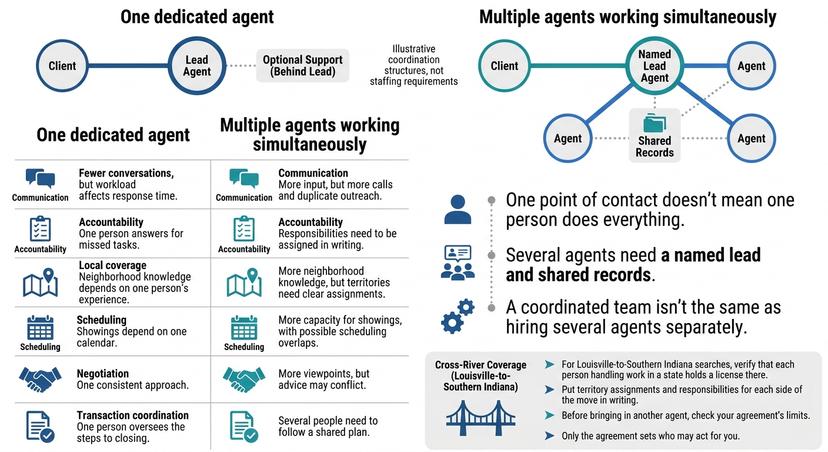
One Agent vs. Multiple Agents: Coverage and Coordination
The choice comes down to control, coverage, and coordination.
| Factor | One dedicated agent | Multiple agents working simultaneously |
|---|---|---|
| Communication | Fewer conversations, but workload affects response time. | More input, but more calls and duplicate outreach. |
| Accountability | One person answers for missed tasks. | Responsibilities need to be assigned in writing. |
| Local coverage | Neighborhood knowledge depends on one person’s experience. | More neighborhood knowledge, but territories need clear assignments. |
| Scheduling | Showings depend on one calendar. | More capacity for showings, with possible scheduling overlaps. |
| Negotiation | One consistent approach. | More viewpoints, but advice may conflict. |
| Transaction coordination | One person oversees the steps to closing. | Several people need to follow a shared plan. |
One Agent Provides a Single Point of Contact
One agent ties your search and showings to offers, negotiations, and contract deadlines. If you’re selling, that work includes pricing, marketing, disclosures, showing feedback, and offers.
One point of contact doesn’t mean one person does everything. Your agent may use support staff or a licensed backup. How well that works depends on clear handoffs, enough availability, and knowledge of the communities involved.
Multiple Agents Require More Coordination
More coverage helps only when someone coordinates the work. Several agents can bring neighborhood knowledge and professional networks, but they need a named lead and shared records. For a purchase, put in writing who handles each property, prepares the offer, and works with inspectors, the lender, and closing professionals.
Different pricing opinions can also lead to conflicting instructions. A co-listing arrangement should spell out who controls the listing record, photography, advertising, showing access, feedback, and offer presentation. The listing agreement must authorize any added role.
Cross-river moves add another layer: licensing and territory.
Verify Coverage on Both Sides of the River
For Louisville-to-Southern Indiana searches, verify that each person handling work in a state holds a license there. A coordinated team isn’t the same as hiring several agents separately.
Put territory assignments and responsibilities for each side of the move in writing. Before bringing in another agent, check your agreement’s limits. Only the agreement sets who may act for you.
Review Your Agreement Before Adding an Agent
If more than one agent might help, your existing contract determines whether another can join. Adding a second agent does not cancel your current contract. Overlapping agreements can lead to duplicate compensation claims.
Check Exclusivity, Coverage, and Compensation
Review the contract’s term, exclusivity, territory, covered properties, promised services, and compensation triggers. Also check termination rules, notice requirements, and any protection period - the window after termination when you may still owe a fee. Compensation is negotiable, not fixed by law.
Ask the brokerage to explain unclear terms. Put any division of responsibilities in a signed amendment that states whether exclusivity changes, who may receive payment, and whether you could owe compensation directly if no other party pays the agreed amount. If you switch brokerages, get a written release listing any remaining obligations.
Understand Agency Duties and Limits
Next, confirm who legally represents you. Agency duties generally include loyalty, confidentiality, disclosure of material facts, following lawful instructions, and advocating for your interests. Not every agent involved in the deal represents you. Confirm each agent’s role and access to your confidential information.
When one brokerage represents both sides, consent requirements and limits on representation depend on state law and the agency structure. Kentucky allows dual agency and designated agency under specific conditions. Indiana disclosures may differ, so review the applicable form before signing. Ask whether the arrangement requires neutrality during negotiations, and have the brokerage or a licensed real estate attorney explain any unclear limits.
Conclusion: Choose Clear Coverage and Accountability
Compare agents before hiring, then name one clear lead. A dedicated agent is often the better fit if you want consistent advice from your first search through closing.
Choose the Approach That Fits Your Move
For cross-river moves across Louisville, Jeffersonville, and New Albany, focus on verified licensing in both states, local experience, and reliable coverage - not how many agents you have. Multiple professionals can help if your agreement allows it, their duties are clearly divided, and one lead contact coordinates the work.
For sellers, choose one accountable listing manager with a written plan for pricing, marketing, showings, and offers. A photographer or transaction coordinator can support the plan without leaving you to manage their work.
Confirm the Fit Before Signing
Agree on communication channels, response times, service areas, and backup support. Ask who handles urgent offers on evenings and weekends. Then check that the contract reflects what you discussed.
For a final fit check, submit your profile for one human-reviewed introduction. Already have a referral but still feel unsure? Request a second opinion before committing - not a second agreement.
FAQs
Can I attend open houses while working with one agent?
Yes. You can attend open houses to gather information and tour properties while working with one agent. Just keep in mind: the listing agent represents the seller, not you. Their role is to market the property and answer factual questions - not advocate for buyers.
Before sharing sensitive details, such as your budget or negotiation plans, confirm whom the agent represents and agree on a clear plan with your own agent.
Should I use different agents to buy and sell across Kentuckiana?
Use separate representation agreements when buying and selling in Kentuckiana: one with a buyer’s agent for your purchase and another with a listing agent for your sale. Don’t assume one agent automatically handles both, or count on a listing agent to negotiate on your behalf as a buyer.
If you use one agent across Louisville and Southern Indiana, confirm that they’re licensed in both states and have local experience in both markets. Review any signed representation agreements, since their terms may limit your options.
What if my agent isn’t meeting my expectations?
Start by reviewing your signed representation agreement. Check which services it covers, its cancellation terms, and what you need to do to end the relationship.
If you’re unhappy with an introduction through our service, let our team know. We can talk through your concerns and discuss whether another introduction makes sense. You don’t have to keep working with an agent who isn’t the right fit, but you do need to follow your agreement’s requirements for ending the relationship.
Ready for a thoughtful introduction?
Tell us about your move. Get one carefully selected introduction. No obligation to hire.
Find my agent ↗