
Louisville’s Two-Speed Market: Why Some Homes Sit
Why some Louisville homes sell fast while others sit: compare price, condition, location, and monthly costs to guide buyers and sellers.
- Agent Selection
- Local Market
- Real Estate
My starting point for any Louisville listing: compare its price, condition, location, and monthly costs with nearby homes - not just its days on market. If you’re selling, address the main reason buyers pass. If you’re buying, set your spending limit before making an offer.
Greater Louisville’s average cumulative days on market rose from 38 in June 2025 to 47 in June 2026 - about 24%, according to the regional report. But that average isn’t a deadline for your home.
Here’s what I’d check first:
- Price and total costs: Compare similar homes, mortgage payments, taxes, insurance, HOA fees, and repairs.
- Condition and location: Weigh maintenance, layout, parking, commute, flood risk, and resale concerns.
- Competition and access: Check what nearby listings offer and how easily buyers can tour yours.
- Your next move: Sellers can use showing feedback to choose a price, repair, or terms change. Buyers can use repair estimates and listing history to support an offer while keeping purchase protections.
My rule: <u>let the property details guide the decision</u>. A fast sale doesn’t prove a good buy, and a long listing doesn’t prove a bargain.
Louisville Housing Market: Are Homes Sitting Longer?
What Makes a Home Attract Offers - or Sit
Regional averages provide context, but buyers compare each home with what’s available nearby right now. Homes attract offers when buyers see better overall value than the alternatives. That includes price, monthly costs, condition, location, layout, parking, repairs, and seller terms.
The fastest-selling listings usually get the mix of price, condition, and buyer fit right - not just one factor. Homes that fall outside buyers’ search filters or expectations can sit.
| Factor | More likely to attract early competition | More likely to linger |
|---|---|---|
| Pricing | In line with comparable sales and active listings | Priced above comparable alternatives without something to justify the difference |
| Condition | Clean, maintained, and ready for financing and occupancy | Deferred maintenance, odors, clutter, aging systems, or uncertainty about inspection findings |
| Location | Meets buyers’ needs for commuting, parking, noise levels, and amenities | Drawbacks that are difficult or expensive to change |
| Competing inventory | Few comparable homes with similar prices and features | Nearby homes offer more space, better condition, garages, or lower costs |
Asking Price and Monthly Costs
An asking price works only if the monthly payment fits the buyer’s budget. Assess it against three sources: closed sales, active listings, and reliable pending listings. Final sale prices may not be public until closing. Compare condition, square footage, parking, renovations, and concessions - not bedroom count alone. An overpriced home can fall outside buyers’ search filters before they see it, cutting early inquiries and showings.
The same asking price doesn’t mean the same monthly cost. Affordability depends on principal and interest at current mortgage rates, property taxes, homeowners insurance, mortgage insurance when applicable, HOA fees, utilities, and expected repairs. Sellers should provide accurate tax and HOA details. Buyers should check estimates with their lender, insurer, tax authority, and HOA documents.
Condition and Location Tradeoffs
A home doesn’t need a renovation to sell, but its price should account for its risks. Cleanliness, odors, and clutter shape first impressions. Roof, HVAC, plumbing, electrical, moisture, and foundation concerns affect repair budgets and inspection decisions. Unresolved defects or location drawbacks can send buyers to competing listings.
Document work on major systems and fix minor defects. When assessing location, check traffic, noise, flood risk, drainage, parking, commute routes, and amenities at different times of day. Verify school assignments through official district enrollment sources, not listing remarks or informal rankings.
Nearby Competition and Showing Access
Even a well-priced home can lag when stronger nearby options are easier to view or compare. Buyers measure it against the best alternatives within their budget and search area. A garage, better storage, a usable layout, or lower ownership costs can matter more than extra square footage.
Make those comparisons easier with accurate room sizes, clear photos, disclosures, and useful feature details. Fix listing errors promptly, and keep showings easy, safe, and uncluttered. Early exposure gives active buyers a chance to assess the home. Restricted access can hurt demand, but easy showings alone won’t produce offers.
How Sellers Can Assess a Stalled Listing
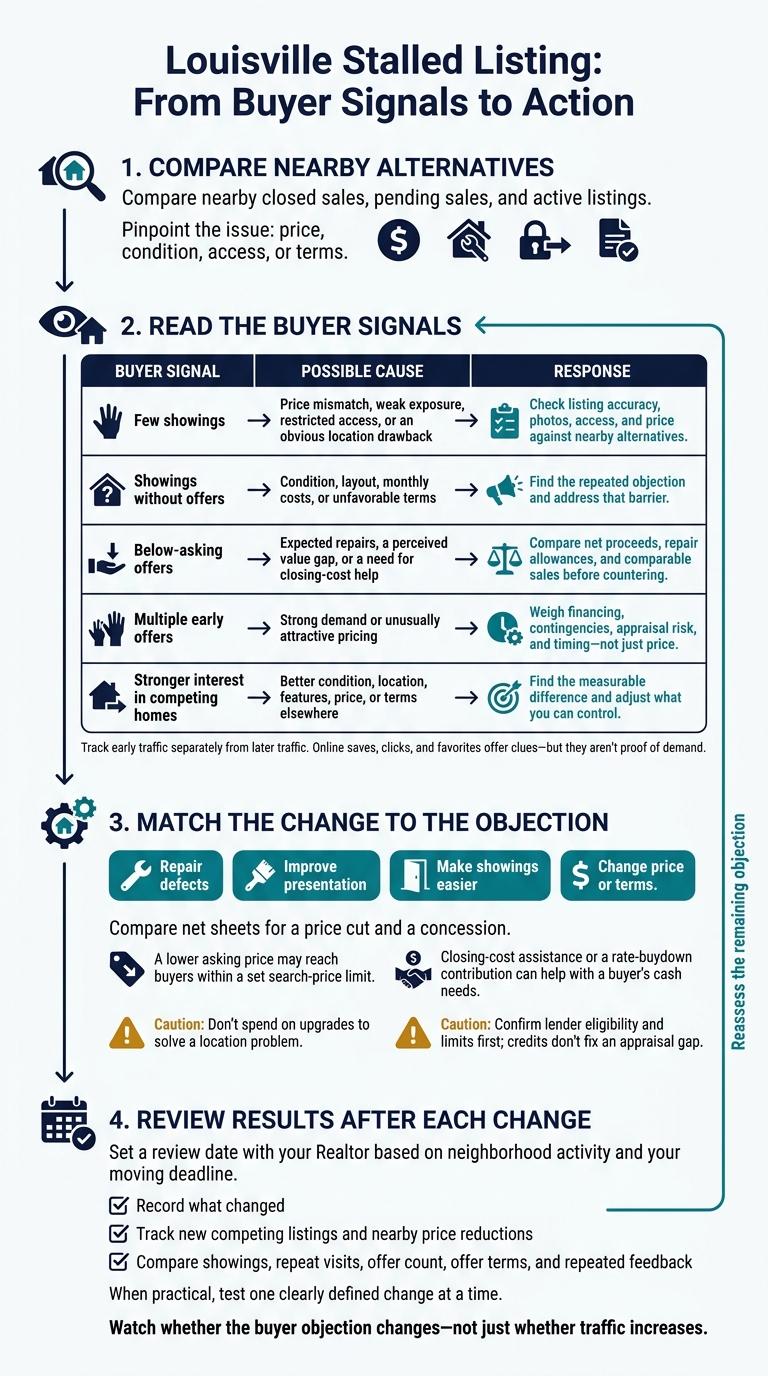
Louisville Stalled Listing: From Buyer Signals to Action
A listing usually stalls because buyers see a better option nearby. The next step is to identify what’s holding buyers back, not guess at fixes. Compare nearby closed sales, pending sales, and active listings to pinpoint the issue: price, condition, access, or terms. Let that finding guide each change.
Read Showing and Offer Patterns
Track early traffic separately from later traffic. These patterns can help you tell whether the issue is demand, value, or presentation. Compare showings, repeat visits, written offers, offer prices, contingencies, and repeated feedback. Online saves, clicks, and favorites offer clues - but they aren’t proof of demand.
| Observed signal | Possible cause | Appropriate response |
|---|---|---|
| Few showings | Price mismatch, weak exposure, restricted access, or an obvious location drawback | Check listing accuracy, photos, access, and price against nearby alternatives. |
| Showings without offers | Condition, layout, monthly costs, or unfavorable terms | Find the repeated objection and address that barrier. |
| Below-asking offers | Expected repairs, a perceived value gap, or a need for closing-cost help | Compare net proceeds, repair allowances, and comparable sales before countering. |
| Multiple early offers | Strong demand or unusually attractive pricing | Weigh financing, contingencies, appraisal risk, and timing - not just price. |
| Stronger interest in competing homes | Better condition, location, features, price, or terms elsewhere | Find the measurable difference and adjust what you can control. |
Choose Changes to Price, Condition, or Terms
Match your next move to the buyer objection. That might mean repairing defects, improving presentation, making showings easier, or changing the price or terms to account for drawbacks you can’t change. Don’t spend on upgrades to solve a location problem.
Compare net sheets for a price cut and a concession. A lower asking price may put your home in front of buyers who search within a set price limit. Closing-cost assistance or a rate-buydown contribution, meanwhile, can help with a buyer’s cash needs. Confirm lender eligibility and limits first; credits don’t fix an appraisal gap.
Review Results After Each Change
Set a review date with your Realtor based on neighborhood activity and your moving deadline. Record what you changed, then track new competing listings, nearby price reductions, showings, repeat visits, offer count, offer terms, and repeated feedback.
When practical, test one clearly defined change at a time. Watch whether the buyer objection changes - not just whether traffic increases.
How Buyers Can Approach Each Type of Listing
For buyers, the main question is simple: does this home fit your budget, the risks you can accept, and your daily life?
Compare Total Costs and Property Tradeoffs
Compare ownership costs, not just the asking price. Before setting your offer limit, get lender and insurance estimates for the property. Include principal, interest, property taxes, homeowners insurance, flood insurance if needed, mortgage insurance, HOA dues, utilities, maintenance, and immediate repairs. Use parcel-specific tax and HOA figures rather than regional averages. Factor in commute time, fuel, parking, and bridge tolls where they apply.
Homes can sit when their total cost or tradeoffs compare poorly with nearby options. Look at square footage, usable layout, and location - not price alone. Visit during your usual commute hours to check traffic, parking, and noise. Think about whether stairs, limited storage, or an awkward floor plan will still work for you later.
Get contractor estimates for major repairs. A lower price may save little if repairs delay your move-in or a busy road limits future resale demand.
Set Offer Limits and Protect Your Purchase
Set your spending ceiling before bidding. Account for the monthly payment, cash needed at closing, repairs, reserves, and any appraisal gap. Strong preapproval and a flexible closing date can help your offer without giving up protections. Even when a home sells fast, inspection, appraisal, and financing contingencies help you assess separate risks before committing.
| Consideration | Home with competing offers | Longer-listed home |
|---|---|---|
| Value check | Compare the likely offer price with recent, similar sales. | Review comparable sales, price changes, and withdrawn or relisted periods. |
| Property checks | Arrange inspections and confirm insurance before applicable deadlines. | Review disclosures, available prior inspection information, maintenance, and insurance concerns. |
| Offer approach | Stay within your ceiling; weigh financing, timing, and contingencies. | Support price or credit requests with repair estimates or market evidence. |
A long listing proves neither a bargain nor weak demand. The property may have financing or condition problems. Or the owner may have no reason to accept less. Read the disclosures and full listing history before deciding what to request.
A local Realtor can help you test your offer limits against current Louisville inventory.
Choose a Realtor With Local Experience
When listings move at different speeds, local guidance can help you assess value, competition, and risk faster. Ask about the Realtor’s recent work in your target neighborhoods and property type. Find out how they compare sales and active alternatives, and who handles showings or deadlines when they’re unavailable. Agree on communication channels and expected response times.
Agent Intro matches Greater Louisville and Southern Indiana buyers and sellers with one local Realtor based on experience, availability, and working style. It also offers a second-opinion introduction if you already have an agent in mind. Interview the Realtor and confirm licensing, compensation, and representation terms before proceeding.
Conclusion: Let Property Details Guide Your Next Step
Louisville homes don’t all sell at the same pace. Some draw quick offers. Others sit because nearby options offer more. After comparing price, condition, location, and monthly costs, ask what the property’s details support. Sellers need to address what’s holding buyers back. Buyers need to weigh value against risk - not just count days on market.
Use those comparisons and the listing history to pinpoint the main obstacle. Then choose one focused response: price, condition, or terms.
Sellers should review results after several showings or 7–14 days, depending on activity. Compare showings, feedback, and offers with the previous period and updated comparable sales. Then address the buyer objection that remains. Let the evidence - not the original asking price or money already spent - guide the next decision.
FAQs
How much should I cut my Louisville home's price?
Base your price cut on recent sold, pending, and active listings in your neighborhood, not citywide averages. Look for patterns in comparable sales and showing feedback before deciding how much to reduce the price.
If your home has been on the market for 30 to 45 days without an offer, it may be priced too high compared with nearby homes. A cut backed by local data can help you avoid the added costs of staying on the market.
Should I get a pre-listing inspection?
Talk with your real estate agent before scheduling a pre-listing inspection, especially if you have an older home. It can give you time to address issues on your schedule instead of reacting to a buyer’s inspection. But it may also reveal problems you’re legally required to disclose.
Before booking, clean up, make sure areas the inspector needs to check are easy to reach, and take care of obvious safety issues or overdue maintenance that a buyer’s inspector will likely flag.
How can I tell if a stale listing is overpriced?
Going 30 to 45 days without an offer is a sign that your pricing or marketing may need a reset. If buyers tour the home but don’t make offers, the price may be out of line with competing homes.
Compare your asking price with recent sales of similar homes in the same neighborhood, not citywide averages. If your price is much higher - or your listing gets little interest while similar homes nearby sell - it may be overpriced.
Ready for a thoughtful introduction?
Tell us about your move. Get one carefully selected introduction. No obligation to hire.
Find my agent ↗