
How Local Market Knowledge Affects Your Home Sale
Use neighborhood comps, local demand, and timing to price, market, and negotiate your home sale for better offers.
- Agent Selection
- Local Market
- Real Estate

Local market knowledge can change your sale price, time on market, and how much you give up in negotiations.
If I were selling a home, I would not rely on citywide averages or online estimates alone. I would want an agent who knows my subdivision, school boundary, lot type, commute patterns, and the buyers most likely to make an offer. In many markets, the first 48 hours matter most, and after about 30 to 45 days without an offer, sellers often need to adjust price or marketing.
Here’s the short version:
- Price with neighborhood comps, not metro averages
- Use sold, active, and pending listings
- Check school lines, floodplain status, lot shape, and road noise
- Market to the most likely buyer, not everyone
- Watch local inventory, days on market, and sale-to-list ratio
- Ask agents for 3 to 5 nearby closings and clear pricing logic
- Have a plan if showings or offers are slow
A home does not sell in a citywide average. It sells in a very specific pocket of the market. That is what this article explains.
Pricing a home correctly starts with neighborhood-specific data
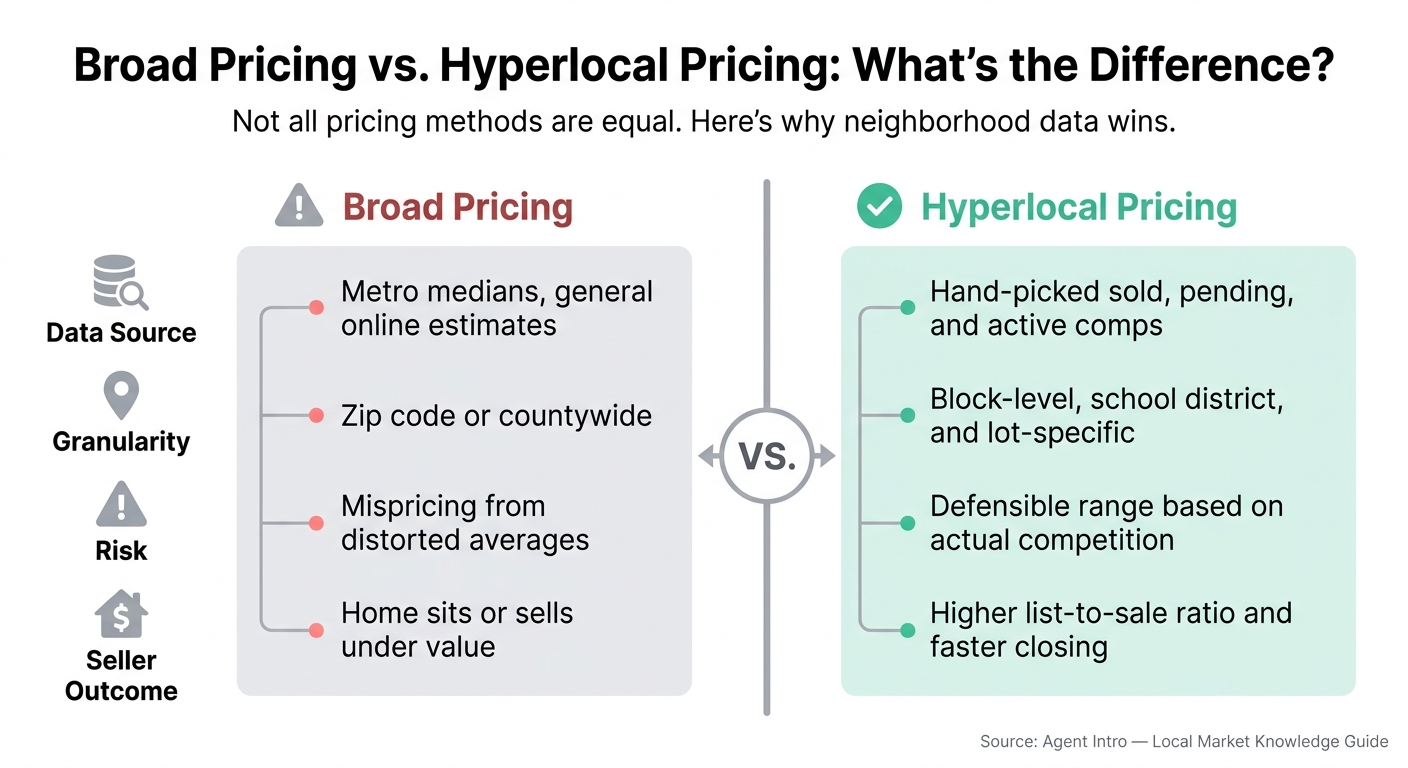
Broad Pricing vs. Hyperlocal Pricing: What's the Difference?
Accurate pricing starts with neighborhood comps, not metro averages. The homes that sold on your block, in your school district, and on a lot like yours are what set a defensible price. Countywide numbers often blur the details that matter most.
Why broad averages can misprice a home
Metro-wide medians and general online estimates often miss what’s happening at the neighborhood level. They can also skew pricing when lot size and lot shape throw off price-per-square-foot numbers pulled from broad averages.
| Broad pricing | Hyperlocal pricing | |
|---|---|---|
| Data source | Metro medians, general online estimates | Hand-picked sold, pending, and active comps |
| Granularity | Zip code or countywide | Block-level, school district, and lot-specific |
| Risk | Mispricing from distorted averages | Defensible range based on actual competition |
| Seller outcome | Home sits or sells under value | Higher list-to-sale ratio and faster closing |
What a strong pricing analysis should include
A solid pricing analysis goes well beyond square footage. You should expect 3 to 6 hand-picked recent sold comps that closely match your home’s location, condition, layout, and lot, not a giant dump of half-related sales from across the county.
That analysis should also include active listings, which show your direct competition on day one, and pending sales, which give a read on where the market is moving right now.
The other big piece is adjustments. If your home has a new roof, updated HVAC, a finished basement, or sits near a busy road, those pricing changes should be spelled out clearly. The same goes for school boundaries or nearby development. Once the price is defensible, local demand can guide the listing plan.
Local demand shapes buyer targeting and marketing
Once pricing is set with neighborhood data, the next step is simple: figure out who is most likely to buy the home. A strong local agent doesn't try to market the property to everyone. They narrow in on the buyer pool most likely to act, then shape the listing plan around that group. That means using neighborhood-level data and paying attention to the search habits that guide online behavior. When the audience changes, the message changes too. So do the marketing channels.
How county, school district, and commute patterns change demand
Buyer demand can shift fast from one nearby area to another. A county line, a school district boundary, or an easier commute can change who is looking and what they care about. Price tier matters too. A local agent reads those signals and uses them to choose the right marketing plan instead of running the same campaign for every listing.
Relocation buyers often start with lifestyle searches, not generic real estate terms. They may look up the "pros and cons" of certain neighborhoods or search for "what it is like to live in [City]" before they ever search for homes. That's why a local plan should focus on the details that matter most to that group, whether that's commute access, neighborhood feel, or the price range they're considering.
An agent who knows these patterns can go after the right buyer group from day one instead of just hoping the right person stumbles across the listing.
How hyperlocal features should shape the listing strategy
A home's features should shape how it's positioned and which buyer it's meant to attract. A finished basement, three-car garage, mature trees, large lot, or covered outdoor living space can each speak to a different set of priorities. The same goes for location details like being close to parks, dining areas, or a key commuter route.
The same house can be marketed in very different ways depending on the neighborhood segment. In one area, it may make sense to lead with nearby anchors and commute convenience. In another, the better move may be to highlight updated finishes, garage space, and fit for the target buyer.
A good local agent builds that story on purpose. The photography, listing headline, social posts, and email outreach to buyer contacts should all reflect who is most likely to buy, not just what the home includes. That positioning can shape how fast the listing gets traction and how strong the first offers are. It can also affect showing activity, days on market, and how much leverage you have in negotiations.
Timing, days on market, and negotiation depend on local conditions
Once you've set the price and narrowed in on the right buyer, timing becomes the next lever. Price and positioning do a lot of the heavy lifting, but launch timing often shapes how fast a home gets noticed. In Louisville and Southern Indiana, that timing isn't just about spring vs. fall. It comes down to what's happening right now in your neighborhood - how much competition is sitting on the market, whether pending sales are moving up or down, and whether nearby sellers have started trimming prices.
How local timing affects showing activity and days on market
The best time to list depends on a few moving parts: season, current inventory, how ready the home is, and your own moving schedule. For example, if you're listing in a neighborhood with a lot of active competition, you'll usually need sharper pricing or stronger marketing than you would in an area where inventory is tight and pending sales are climbing.
The first 48 hours after a listing goes live bring the most buyer attention. That's the big moment. If the timing is off - or the price comes in too high - you can lose that early push fast. And once it's gone, it's hard to get back.
After 30 to 45 days without an offer, a home often needs a price or marketing reset. Buyers watch days on market more closely than many sellers think. When that number starts climbing, they often read it as a sign that the home is overpriced or stale. That can weaken your position before negotiations even start.
When you talk with agents, ask for neighborhood-level data, not city-wide averages. You want the numbers that match homes like yours, such as:
- current months of inventory
- average days on market
- sale-to-list price ratio
Those figures tell you a lot more about your timing window than a broad claim about the "best" month to sell.
The same local numbers that shape launch timing also show how fast buyers tend to move once a listing hits the market.
Why local knowledge matters during offers and inspections
Local knowledge matters again when offers start coming in. At that stage, it can help you protect your price and avoid giving up too much. A local agent knows whether buyers in your price range are usually coming in near asking or below it. They also know how appraisers are dealing with thin comps in your area, what inspection issues tend to show up in older homes nearby, and how repair credits and possession terms are often handled.
Use return visits, page views, and lead activity to guide pricing, repair, and concession choices. Think of that data as a reality check. It can help you stand firm on price or push back on repair credit requests instead of reacting out of stress. That leads to better price retention, fewer concessions you didn't need to make, and stronger appraisal support - all tied to knowing how buyers act in your market.
How to evaluate an agent's local market knowledge before you list
The next step is simple: test whether an agent can prove their local knowledge in the interview.
This part matters more than many sellers think. Plenty of agents can talk in broad terms about the market. What you want is someone who knows your area, not just the city at large. The interview helps you spot the difference between real neighborhood experience and generic sales talk.
What to look for in a local listing agent
Start with a few direct checks:
- Recent closings in your neighborhood. Ask for 3 to 5 recent closings in your neighborhood or subdivision. Agents with that kind of transaction history are more likely to price with more precision and pick comps that can stand up under scrutiny.
- Street- or neighborhood-level metrics, not ZIP code averages. If an agent can pull current data at that level - not just countywide numbers - they usually have a better sense of your direct competition.
- Pricing logic you can follow. Ask for the comparable sales they'd use, then have them walk you through the adjustments. If they can't explain why they added or subtracted value for certain features, that's a red flag.
- A clear plan for slow activity. Ask what happens if your home isn't getting showings or offers. You should hear a defined price-review trigger and a set communication schedule - not vague reassurance.
If you're selling in Kentuckiana, get even more specific. Ask how Louisville and Southern Indiana differ when it comes to taxes, commute patterns, and school boundaries.
That kind of question tends to separate agents who know the area from agents who just work somewhere nearby.
If the answers stay vague, a matching service can help narrow the field to agents with proven local experience.
Using Agent Intro to find a better local match
Agent Intro matches sellers in Greater Louisville or Southern Indiana with one Realtor based on local experience, availability, and communication style - not on paid placement.
If you already have an agent in mind but want a second opinion before you commit, Agent Intro offers that too. It gives you a way to check whether the agent you're considering fits your neighborhood and your situation.
FAQs
How many comps should an agent use?
For a Comparative Market Analysis, an agent should usually use three to five carefully chosen comparable sales.
A smaller group of strong, relevant comps is often more useful than a bigger batch of weaker data. The best comps closely match the property, with clear adjustments for condition, size, and location.
What if my home gets no offers?
If your home gets no offers, your pricing strategy or market position likely needs another look. In many cases, the list price just doesn’t match what buyers in your neighborhood are willing to pay right now.
Your agent should go back through recent comparable sales, average days on market, and your marketing plan - including photography, staging, and digital reach. They should also keep you up to date on showing feedback, so you can make informed decisions as you go.
How do I test an agent’s local knowledge?
Ask for verifiable data, not broad claims. Request their MLS transaction history from the past 12 months in your target neighborhoods and price range. Three to five closed deals in those submarkets can show that they know the area and how it moves.
It also helps to ask about a recent off-market property they found, how they found it, and how they’d handle a specific property type based on local days on market and competition. That’s where you start to see whether they have actual know-how or just a polished pitch.
Watch for vague answers. And be careful if they push you to sign a long-term exclusive agreement before they’ve shown any proof of their work.
Ready for a thoughtful introduction?
Tell us about your move. Get one carefully selected introduction — free for buyers and sellers.
Find my agent ↗