
The Fed Meets Oct 27 to 28. What It Can and Can't Do to Your Mortgage Rate
The Fed sets a short-term bank rate, not your mortgage rate. What the Oct 27 to 28 meeting can change, what it can't, and what half a point means on $250,000.
- buying
- mortgage rates
- Kentuckiana
- Southern Indiana
Key takeaways
- The Fed doesn't set your mortgage rate. It sets the federal funds rate, a short-term rate banks charge each other overnight. Lenders set mortgage rates.
- Mortgage rates follow the bond market. The 30-year rate tends to move with the 10-year Treasury yield, which reacts to inflation news.
- Markets price the meeting in early. As of Oct 19, futures pricing showed roughly an 80% to 84% chance the Fed holds on Oct 28, per CME FedWatch figures reported by third parties. Those odds moved fast this month.
- A half point is real money. On a $250,000, 30-year loan, 7.5% costs $84.78 a month more than 7.0% in principal and interest.
- Plan on the payment, not the headline. A member of our team will review your Match Profile before we introduce you to one of our vetted local real estate agents.
Table of contents
- Does the Fed set mortgage rates?
- What the Fed can do
- What the Fed can't do
- What the market expects this time
- What a half point costs on $250,000
- Should I wait for the Fed to buy?
- Get a plan for your budget
- FAQs
TL;DR: The Fed meets Oct 27 to 28, but it doesn't set mortgage rates. It sets a short-term rate for banks. Mortgage rates follow the 10-year Treasury yield and inflation news, and markets usually price a Fed move in before it happens. So the meeting alone rarely moves 30-year rates much. Plan around a payment you can carry.
This post explains what the meeting can and can't do. It doesn't predict what the Fed will decide or where rates will go.
Does the Fed set mortgage rates?
Short answer: no. The Fed sets the federal funds rate, and lenders set mortgage rates.
The federal funds rate is what banks charge each other for overnight loans. The Federal Reserve's policy committee sets a target range for it. After a 0.25 point hike in September, that range is 3.75% to 4.00%.
Your 30-year fixed rate is a different number. Lenders set it based on market conditions, their own costs, and your loan details, as the Consumer Financial Protection Bureau explains. The market piece is mostly the 10-year Treasury yield. Investors who buy mortgage bonds compare them with Treasurys, so the two tend to move together, with a gap in between for lender costs and the risk that borrowers refinance early.
That's why the 30-year rate can rise on a day the Fed does nothing.
What the Fed can do
Short answer: it moves short-term borrowing costs right away and nudges long-term rates through expectations.
- Change the federal funds rate. That flows straight into the prime rate, which many credit cards and home equity lines of credit (HELOCs) follow. If you carry a HELOC or a card balance, a hike shows up there first.
- Shape expectations. The Fed's statement and the chair's press conference tell markets how worried officials are about inflation. That outlook can move the 10-year yield, and mortgage rates with it.
- Signal the path ahead. Markets care as much about the next few meetings as this one. A hold with a tough tone can push rates up. A hike that everyone expected can do very little.
What the Fed can't do
Short answer: it can't hand you a lower mortgage rate on demand.
- It can't set your rate. Your rate depends on the bond market, your credit, your down payment, the loan type, and points.
- It can't make a cut lower long-term rates by itself. If investors think inflation will run hot, the 10-year yield can rise even after a cut. A cut also isn't being priced right now.
- It can't undo what's already priced in. When markets expect a decision, mortgage rates have usually moved before the meeting. Surprises move rates more than the decision does.
Here's an example from this month. On Oct 14, the September inflation report came in hotter than expected: consumer prices were up 3.7% YoY, above the 3.6% forecast, with energy prices a big part of the jump. The average daily 30-year rate went from 7.46% to 7.56% that day before settling near 7.5%, according to Mortgage News Daily's daily index. That move came two weeks before the Fed meets.
What the market expects this time
Short answer: as of Oct 19, markets leaned toward a hold in October and a hike by December. Those odds can change in a day.
Traders use fed funds futures to price the odds of each outcome, and CME FedWatch turns those prices into percentages. We could not pull figures directly from CME, so these come from outlets that reported or recreated the CME FedWatch numbers:
| As of | October 28 hold | October 28 hike (0.25 point) | Cut |
|---|---|---|---|
| Oct 18 (reported by Prediction.com) | about 83% | 17% | about 0% |
| Oct 19 (reported by FXBus) | 83.9% | 16.1% | 0% |
| Oct 19, end of day (FedWatch method, kryptomagazin terminal) | 80.0% | 20.0% | 0% |
For the December 8 to 9 meeting, the same Oct 19 sources priced roughly a 90% chance of at least one more 0.25 point hike by then.
These odds moved fast. Right after the Oct 14 inflation report, reported odds of an October hike jumped sharply. They fell back after a weak September jobs report showed just 29,000 jobs added. Treat any number here as a snapshot, not a forecast. Check CME FedWatch for the latest before you make a decision.
What each outcome usually means for mortgage rates:
- Hold (what markets lean toward): little change on the day, since it's already priced in. Watch the statement and the next inflation report.
- Hike: if expected, a modest effect. If it's a surprise, mortgage rates can tick up. Card and HELOC rates rise directly.
- Cut: not priced at all. Even then, lower mortgage rates aren't guaranteed if inflation worries push the 10-year yield up.
What a half point costs on $250,000
Short answer: $84.78 a month, or about $1,017 a year, on a $250,000, 30-year fixed loan.
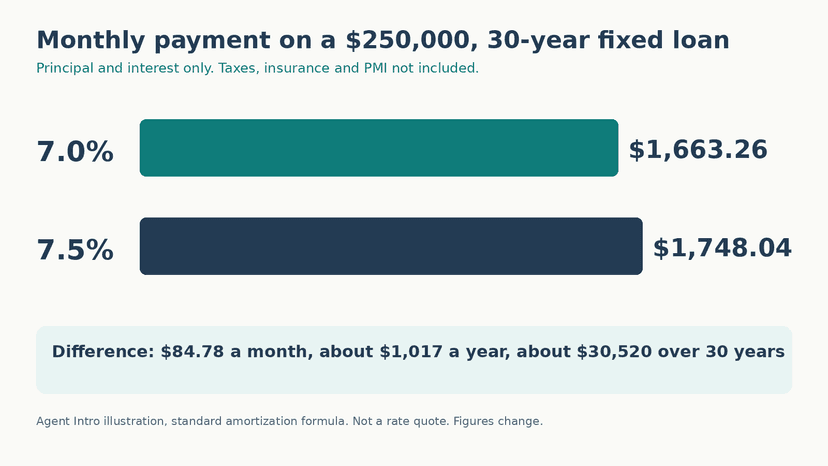
| Rate | Monthly principal and interest |
|---|---|
| 7.0% | $1,663.26 |
| 7.5% | $1,748.04 |
| Difference | $84.78 a month, about $1,017 a year, about $30,520 over 30 years |
This is an Agent Intro illustration using the standard loan payment formula. It leaves out property taxes, homeowners insurance, and mortgage insurance, which add to the real monthly cost. For context, Freddie Mac's weekly survey put the average 30-year fixed rate at 7.40% on Oct 15, 2026, compared with 6.27% a year earlier.
Small moves add up, but they're smaller than most headlines suggest. A 0.25 point change on the same loan is roughly $42 a month.
Should I wait for the Fed to buy?
Short answer: the meeting by itself is unlikely to change your decision. Your budget and timeline should.
Waiting for one meeting has a cost too. Rates may not fall soon, rent keeps coming due, and prices can keep moving. Some steps make sense either way:
- Know your number. Decide the monthly payment you can carry with taxes and insurance included, at today's rates.
- Ask about rate locks. Ask your loan officer how long a lock lasts, what it costs, and whether a float-down option is available.
- Compare loan estimates. Rates and fees differ between lenders on the same day. Compare at least two official Loan Estimates.
- Ask about seller concessions. In a slower market, some sellers will help with closing costs or a rate buydown. Our post on buyer leverage at 7% rates covers how that works.
Get a plan for your budget
Short answer: a good local agent helps you shop the payment, not the headline.
Agent Intro is an introduction and referral service of Aire Realty, LLC, an Indiana-licensed real estate brokerage, serving home buyers and sellers in Southern Indiana and Greater Louisville. Fill out a short Match Profile. A member of our team will review your Match Profile, then introduce you to one of our vetted local real estate agents who fits your plans. You are never obligated to hire anyone.
Thinking about buying this fall? See how we help at Buying, or open a buy-intent Match Profile.
Related reading:
- Rates Are Over 7%. How Buyers Still Negotiate in Southern Indiana
- Should Sellers Offer Closing Cost Assistance in Southern Indiana?
- FHA Credit Score Change 2027: VantageScore and FICO 10T
Disclosure: The agent we introduce may be affiliated with Aire Realty, LLC, which operates Agent Intro. If so, we tell you when we make the introduction. Agent Intro earns a referral fee when an introduction leads to a closed transaction. When the introduction is to a partner brokerage, that brokerage pays the fee to Aire Realty, LLC. Full details are on our Disclosure page. This post is general information, not financial, legal, tax, or lending advice. Rates, market odds, and figures change daily. Confirm current numbers with a licensed loan officer before you act.
FAQs
Does the Fed set mortgage rates?
No. The Fed sets the federal funds rate, a short-term rate banks charge each other overnight. Lenders set mortgage rates, which tend to follow the 10-year Treasury yield.
Will mortgage rates go down after the Fed meeting?
Not necessarily. Markets usually price the decision in before the meeting, so rates often move more on surprises, the Fed's outlook, and the next inflation report than on the decision itself.
What happens to mortgage rates if the Fed raises rates?
If the hike is expected, mortgage rates may barely move. A surprise hike can push them up. Credit card and HELOC rates tied to prime rise directly.
How much does a half point change my payment?
On a $250,000, 30-year fixed loan, 7.5% costs $84.78 a month more than 7.0% in principal and interest, about $1,017 a year. Taxes and insurance are extra.
Should I wait for the Fed before buying a house?
The meeting alone is unlikely to change rates much. Base the decision on a payment you can carry and your timeline, and ask a loan officer about rate lock options.
Data note: Fed policy range and September CPI (3.7% YoY, consensus 3.6%): CNBC, Oct 14, 2026, citing BLS data. Daily 30-year rate move: Real Estate News, Oct 14, 2026, citing Mortgage News Daily's daily index. Weekly average rate: Freddie Mac PMMS, Oct 15, 2026. Fed meeting odds: CME FedWatch figures as reported by Prediction.com (Oct 18), FXBus (Oct 19) and the kryptomagazin FedWatch terminal (Oct 19, end of day). Jobs figure: Prediction.com, Oct 18, 2026. Payment example: Agent Intro illustration, standard amortization formula, principal and interest only. General background: Federal Reserve, Consumer Financial Protection Bureau.
Ready for a thoughtful introduction?
Tell us about your move. Get one carefully selected introduction. No obligation to hire.
Find my agent ↗