
Too Many Agent Calls: How to Avoid the Overwhelm
Use one contact, set clear communication rules, and ask a few screening questions to stop nonstop agent calls and find a local match.
- Agent Selection
- Local Market
- Real Estate

One real estate request can trigger texts, emails, and phone calls within 60 seconds. If I want less noise and more control, I need to limit who gets my info, set contact rules early, and use a short screening process before I choose an agent.
Here’s the short version:
- One form can reach several agents at once, which can lead to stacked follow-ups across multiple channels.
- 62% of real estate inquiries happen at night or on weekends, so the first wave often lands at the worst time.
- The first agent to reply is not always the right one for Louisville, Clark County, Floyd County, or a specific neighborhood.
- One introduction at a time keeps the process simple and cuts down on extra calls.
- Clear rules help from the start: I can set my contact method, time window, and update schedule before the first full conversation.
- A few screening questions are enough to check local experience, current workload, communication style, and fit for my move.
Instead of giving my details to a broad list, I’m better off using a simple plan:
- Share my request with one contact source
- Ask for one matched agent
- Set written contact preferences
- Ask 1–3 questions before moving forward
If I do that, I’m far less likely to deal with nonstop follow-up for days or weeks. The point is simple: less outreach, better control, and a cleaner path to the right local agent.
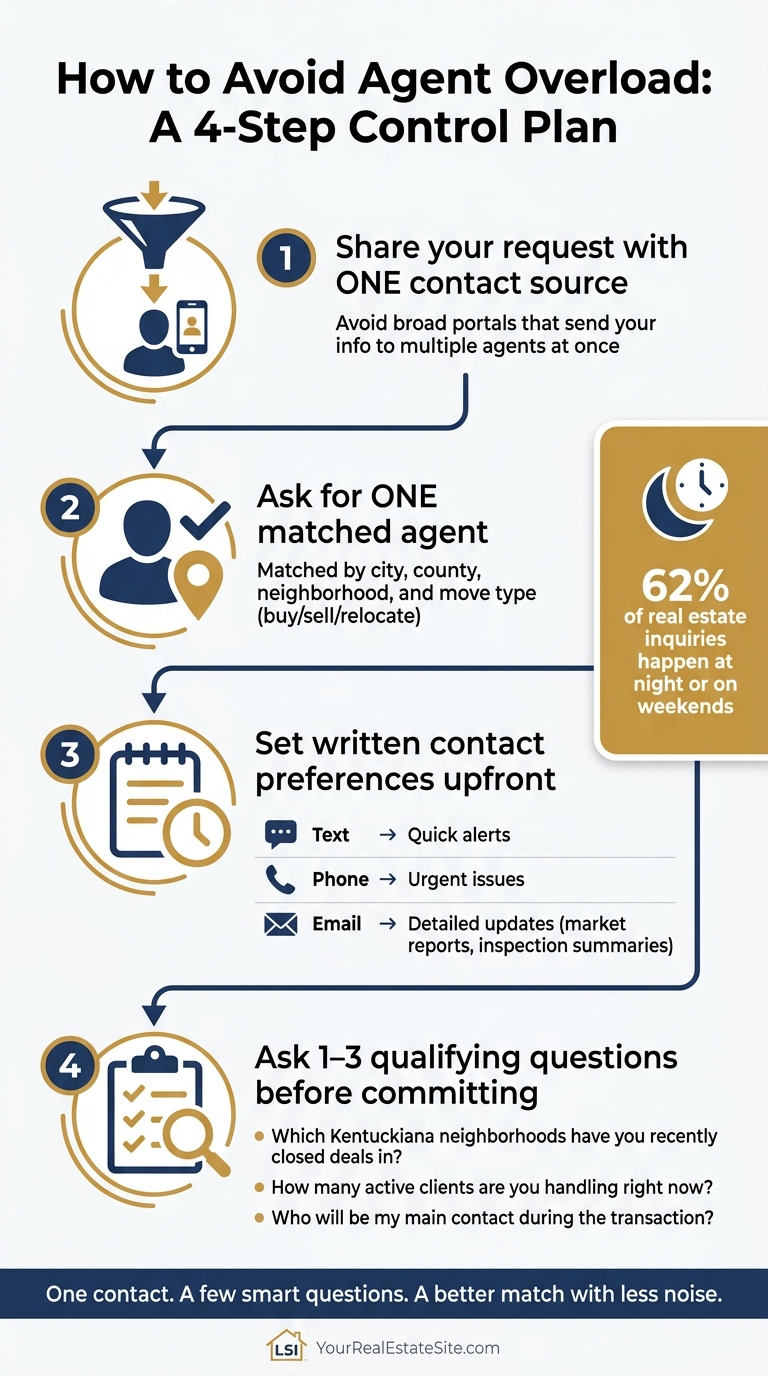
How to Avoid Agent Overload: A 4-Step Control Plan
Why Realtors Won't Stop Calling You
Why agent outreach piles up so fast
A single request can set off a flood of calls, texts, and emails. Submit your info through a real estate portal or lead form, and that request may go to several agents at once. Then each agent starts their own follow-up.
That’s why things can get messy so fast. Before you’ve had time to think, your phone is buzzing from different directions. The smartest next move is to narrow down who gets your request in the first place.
Multiple channels mean multiple conversations to track
Here’s where it gets tiring: each agent may contact you by text, email, and phone at the same time. Now multiply that by several agents, and you’re suddenly juggling a stack of separate conversations before you’ve even had a chance to compare who’s a good fit.
It’s not just a volume problem. It also makes simple decisions harder. Messages pile up, details get scattered, and it becomes tough to keep track of who said what. Once that starts happening, the next issue is picking an agent without enough time to make a clear side-by-side comparison.
Early pressure can push you toward the wrong agent
Fast replies often win business before the client is ready. And that can be a problem.
If you’re taking calls before you’ve settled on your budget, target neighborhood, or timeline, it’s easy to commit too early. Speed can feel reassuring in the moment, but it doesn’t tell you whether an agent knows the area well, has time for your search, or is simply the right match.
Choose based on local knowledge, availability, and fit - not just who reached out first. That early pressure is exactly why the next step is to start with one point of contact.
Start with one point of contact instead of a broad list
The fastest way to avoid agent overload is simple: don’t send your request to a crowd. A single-introduction process looks at your goals, then connects you with one matched Realtor based on area, availability, and working style.
How a single introduction cuts down the noise
When your details go to several agents at the same time, it can spark a race to reply first. That happens because many people pick the first agent who gets back to them. A single introduction takes that pressure off. You share your goals once and review one qualified match at a time.
That means fewer moving parts on your end. Instead of juggling several follow-up threads, you can focus on one conversation and see if the fit feels right. If it doesn’t, ask for one other option.
Why location-specific matching matters in Kentuckiana
Local fit takes more than a broad search. You want a match that narrows by city, county, and neighborhood, not just distance. In a place like Kentuckiana, that kind of detail matters. An agent who knows one pocket well may not be the right fit for another part of the market.
The match should also line up with the kind of move you’re making, whether that’s buying, selling, or relocating. Then, before the first full conversation, set the basics:
- how you want to be contacted
- when you want to hear from them
- how often you want updates
That small bit of setup can save a lot of back-and-forth later.
Set communication ground rules before the first full conversation
Once you’ve matched with an agent, set the ground rules before your first full conversation. In Kentuckiana, clear contact rules can stop one simple request from turning into nonstop calls and messages.
Set your contact method, timing, and update schedule
Pick the best channel for each kind of update. Text works well for quick alerts. Phone calls make sense for urgent issues. Email is better for detailed updates, like market reports or inspection summaries.
Then define what “urgent” means. Offer negotiations, inspection deadlines, and closing problems usually call for a same-day call or an after-hours message. Routine updates can wait until your agreed check-in time.
A simple schedule can help:
| Transaction Stage | Recommended Frequency |
|---|---|
| Active Search or Listing | Weekly |
| Under Contract | Twice-weekly |
| Final Week Before Closing | Daily |
Confirm who will contact you and how quickly
Ask whether the agent will be your main contact or whether someone on the team will step in. Some agents use transaction coordinators or software for deadlines and reminders, so it helps to know who’s actually reaching out.
It’s also smart to ask about normal response times during business hours. That way, you know what to expect without feeling like you need to follow up every few hours. At the same time, there should still be room for fast action when something time-sensitive pops up.
Put your preferences in writing
After your first conversation, send a short text or email that sums up your preferences:
- your main contact channel
- your contact windows
- your update schedule
- your main point of contact
That written note keeps both sides on the same page without slowing down important updates.
With these rules in place, you can focus on whether the agent is a good fit instead of spending your time managing follow-up.
Use a short screening process to make a controlled decision
Once your contact preferences are set, keep the screening process short. That gives you a cleaner way to pick the best fit without piling on more noise.
Ask a short list of questions that shows local fit
You don't need a long interview. Just 1–3 qualifying questions can tell you a lot about whether an agent fits your Kentuckiana move.
Start with local experience. Ask which Louisville neighborhoods or Southern Indiana communities they've recently closed deals in most often, not just where they're licensed. That's a much better signal of local know-how.
Then ask about your kind of move. Experience should match your property type and price point. A first-time buyer in Jeffersonville isn't dealing with the same stuff as someone selling a home in the Highlands. The right agent should be able to point to past deals that look like yours.
Two other questions can save you headaches:
- Who will be your main contact during the transaction?
- How many active clients are you handling right now?
Those answers tell you who you'll actually be dealing with and how thin that agent may be stretched. If someone's juggling a packed client list, your sale or home search may not get the attention it needs.
Use a small comparison table to stay consistent
If you're talking to more than one agent, a simple table keeps your notes in one place and makes side-by-side review much easier.
| Criterion | What to Ask | What it tells you |
|---|---|---|
| Local Experience | Which Kentuckiana neighborhoods have you recently closed deals in? | Specific street-level knowledge and recent local transaction volume |
| Availability | What's your current client load, and who handles day-to-day updates? | Whether you get direct access to the agent and how much bandwidth they have |
| Communication | What's your typical response time and update frequency? | Match with your preferred pace and schedule |
| Transaction Type | Have you handled this property type at this price point before? | Past work with your kind of situation |
Keep your notes short. You're not building a giant spreadsheet. You just want a quick, clean way to compare options.
Conclusion: Stay in control from the first request
Broad outreach is one of the easiest ways to lose control of the process. When too many agents get your contact information at the same time, follow-up stacks up fast across calls, texts, and emails.
Starting with one location-specific introduction cuts that noise before it starts. Clear contact rules reduce repeated follow-up. And a short screening list helps you choose based on fit and local knowledge, not just whoever called first.
The idea is simple: one point of contact, a short screening list, and local fit help you stay in control in Louisville or Southern Indiana.
One contact. A few smart questions. A better match with less noise.
FAQs
How do I stop agent calls after submitting a request?
To avoid too many agent calls, focus on quality over quantity. Reach out to a small group of agents who already look like a good fit, instead of casting a wide net and dealing with a flood of replies.
You can narrow the list with comparison tools or a simple question checklist before you share your contact information. That extra step can save a lot of back-and-forth later.
It also helps to set clear ground rules from the start. Tell agents how you want to be contacted and when you're available. If calls or messages keep coming after that, ask to opt out of any further follow-up.
What should I ask before choosing an agent?
Ask questions that show how the agent works day to day and how they communicate.
For example, find out their typical response time during business hours. Ask how they handle follow-ups if you’re not ready to move yet. And get clear on how often they’ll update you by phone or text.
It also helps to ask for specific results instead of vague promises. Look for numbers like their average days on market and success rates, so you can judge performance based on facts, not just sales talk.
What if the first matched agent isn’t a fit?
If the first agent you’re matched with doesn’t feel like the right fit, you don’t have to keep working with them. You stay in control.
One simple way to test the fit is with a single-property limited agreement. That lets you work with the agent for just one showing or appointment before you commit to anything longer term.
If it doesn’t work for you, you’re free to choose a different professional who lines up better with your goals and preferences.
Ready for a thoughtful introduction?
Tell us about your move. Get one carefully selected introduction — free for buyers and sellers.
Find my agent ↗